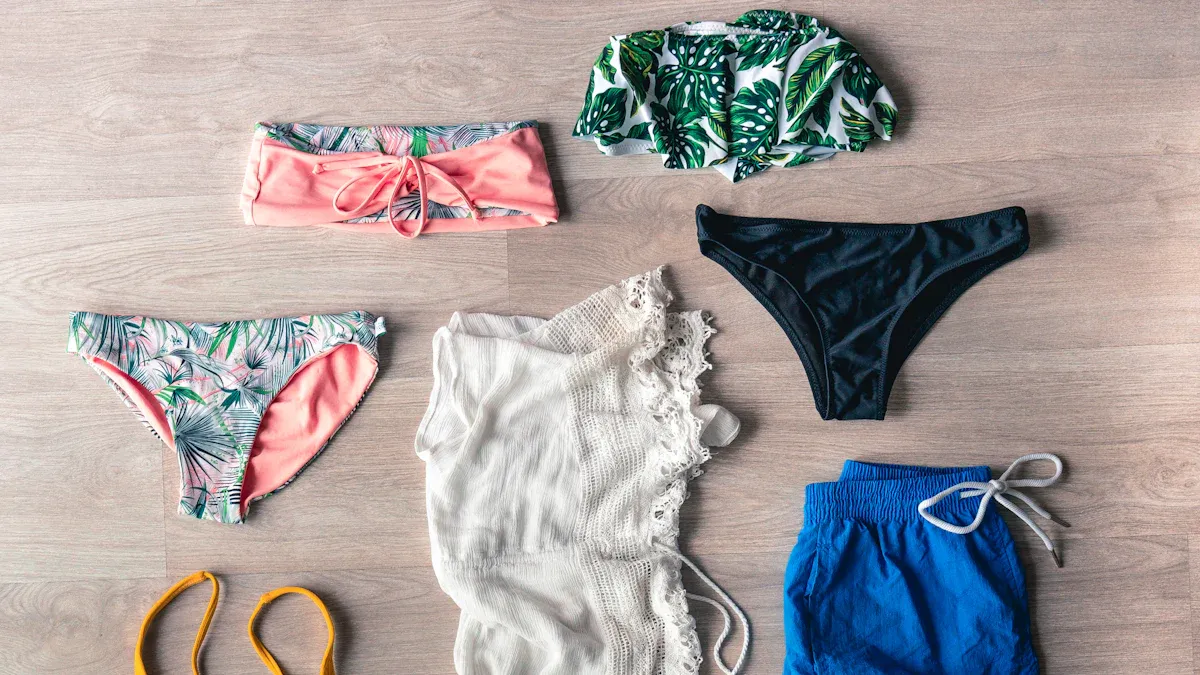
When searching for sustainable swimwear for your business, you need straightforward answers. Nowadays, a growing number of consumers are seeking eco-friendly materials. Currently, over 38% of swimwear incorporates recycled fabrics, and more than 40% of U.S. shoppers favor these options.
Here’s a quick overview of the latest market trends:
Demand Growth | Consumer Preference |
|---|---|
40% prefer eco-friendly |
Utilize this B2B Guide along with Insights on Sustainable Fabrics to assist you in making informed and responsible choices.
Key Takeaways
More people want sustainable swimwear now. Over 38% use recycled materials. This shows that buyers want eco-friendly choices.
Pick materials like ECONYL and REPREVE for swimwear. These fabrics come from recycled waste. They help lower harm to the environment.
Check for certifications like GRS and OEKO-TEX®. These show your swimwear is safe and sustainable.
Buying in bulk can cut costs a lot. Order more at once to save money. This can help you earn more profit.
Build strong ties with suppliers. Talk clearly and work together for a long time. This can get you better prices and quality.
Keep up with market trends. Fast-drying fabrics and inclusive sizing are popular. These features can bring more buyers to your brand.
Follow rules like REACH and GPSD. This keeps your business safe. It also helps customers trust you.
Make a good website and use social media. Fun posts can help people find and stay with your brand.
1. B2B Guide to Sustainable Materials
Image Source: pexels
Eco-Friendly Fabrics
When you want sustainable swimwear, you can pick from a few top materials. Each material helps your business and the planet in different ways.
Material | Description |
|---|---|
Popular fabric made from old nylon found in landfills and oceans. | |
Special material made from used plastic bottles, used in many clothes like swimwear. | |
Recycle Polyester | Fabric made from all recycled polyester, using things like plastic bottles. |
Hemp | Strong, tough, blocks UV rays, fights pests, and does not leak toxins or microplastics. |
Recycled Nylon (ECONYL®)
ECONYL® uses a closed-loop process. It is made from trash like fishing nets and old carpets. It is just as good as new nylon and can be recycled again.
Recycled Polyester (REPREVE®)
REPREVE® comes from recycled plastic bottles. It helps cut down on plastic waste and saves oil. Many big brands use this fabric for swimwear.
While both ECONYL® and REPREVE® support sustainable swimwear production, they differ in performance, texture, and cost. For a quick side-by-side comparison, see ECONYL® vs REPREVE®: Choosing the Right Eco Fabric.
Hemp, Bamboo, Cotton, Zorb
Hemp is strong and blocks UV rays. It does not let out microplastics. Bamboo and organic cotton are soft and let air through. Zorb is a new fabric that soaks up water fast and dries quickly, so it works well for swimwear linings.
When developing a sustainable swimwear line, fabric selection is not just a design decision—it directly impacts your brand’s environmental footprint, product performance, and long-term market positioning. Recycled materials such as ECONYL® nylon and REPREVE® polyester help reduce ocean waste and plastic pollution, while natural fibers like hemp offer durability, UV resistance, and zero microplastic shedding. For brands looking to balance sustainability, comfort, and functionality, understanding the strengths and limitations of each eco-conscious material is essential. To explore these materials in greater depth and compare their real-world applications in custom swimwear production, see Eco-Friendly Fabric Options for Custom Swimwear.
Material Benefits
Environmental Impact
Using recycled materials like polyester and nylon helps save resources and cuts plastic trash. Hemp and bamboo need less water and fewer chemicals than other crops. These materials help keep the earth clean.
Comfort and Durability
Fabrics like recycled polyester, hemp, and bamboo are comfy and last a long time. Good swimwear fabrics do not fade, lose shape, or break down in saltwater, chlorine, or sunlight. Look for things like chlorine resistance, UV protection, and fade resistance to make sure your products last.
Sourcing Tips
Verifying Authenticity
Always look for third-party certifications like the Recycled Claim Standard (RCS) and the Global Recycled Standard (GRS). Check what the supplier does for the environment before you buy. Make sure the supplier gives clear details about their materials and how they make them. Be careful if they make unclear claims about being green.
Certifications to Seek
Certification Name | Purpose |
|---|---|
Global Recycled Standard (GRS) | Checks recycled content |
Makes sure dyes and finishes are safe for skin | |
Bluesign® Approved | Makes sure chemicals are used safely |
Checks for organic content and green practices | |
Fair Trade | Makes sure workers are treated fairly and work is green |
Tip: Use this B2B Guide to compare materials, check certifications, and make smart choices when picking suppliers for your brand.
2. Cost Analysis for B2B Buyers
It is important to know costs when buying sustainable swimwear. This B2B Guide helps you look at prices and plan your spending.
Price Ranges
Sustainable swimwear usually costs more than regular swimwear. The table below shows the average prices for each type. If you buy a lot at once, each piece costs less.
Swimwear Type | Conventional Price | Bulk Price |
|---|---|---|
Bikini Top | $56 | $12 |
One-Piece | $68 | $19 |
Sports Bra | $60 | $15 |
Leggings | $68 | $19 |
Bulk Pricing
Buying in bulk saves you money. When you order more, you pay less for each item. This helps you spend less and make more profit.
Cost Factors
Material, Volume, Customization
Many things change the final price:
Fabric quality: Recycled and eco-certified fabrics cost more but last longer and protect from the sun.
Construction and craftsmanship: Well-made swimwear costs more but lasts longer.
Production methods: Slow-fashion and ethical ways cost more but add value.
Labor and safety: Fair pay and safe work cost more but attract buyers who care.
Environmental responsibility: Green brands often charge higher prices.
Regional Differences
Where you buy your swimwear changes the cost. Different places have their own benefits and prices.
Region | Characteristics | Impact on Sourcing |
|---|---|---|
Guangdong | High-end factories, advanced making, top suppliers | Higher prices, best quality, and new ideas |
Fujian | Leader in green fabrics, eco-friendly materials | Good prices for green options |
Zhejiang | Mass production, strong shipping | Good for medium orders and lower prices |
Xingcheng | Complete swimwear-focused supply chain, highly specialized in swimwear production | Efficient sourcing, strong production capacity, able to support both large-scale orders and emerging swimwear brands |
Budgeting Strategies
Cost-Saving Tips
Start small: Small brands spend less than big ones.
Pick your niche: Focused brands save more money.
Sell online: Online shops cost less to run.
Use social media: Instagram and TikTok help you find buyers for less.
Create content: Helpful posts build trust and bring customers.
Build an email list: Email keeps your buyers interested.
Invest in a good website: A nice site helps your brand grow.
Work with influencers: Influencers help you find new buyers.
Long-Term Value
Sustainable swimwear gives you benefits over time. The table below shows how your money works for you:
Benefit | Description |
|---|---|
Reduced Waste | Less waste means you pay less to throw things away. |
Energy Consumption Savings | Green fabrics use less energy. |
Enhanced Brand Reputation | A green brand makes people trust and like your business. |
Tip: Use these ideas to plan your budget and get the most from buying sustainable swimwear.
3. Compliance & Certifications
You must follow important rules when you buy sustainable swimwear. This part of the B2B Guide explains the main standards and rules. It also shows how to check if suppliers follow them.
Key Standards
OEKO-TEX® 100
OEKO-TEX® Standard 100 checks if swimwear fabrics have bad chemicals. You can trust this label for safe clothes. ISO 9001 means a supplier has good quality systems. BSCI or SEDEX audits show workers are treated well and work safely.
GRS, REACH, EU 2026
The Global Recycled Standard (GRS) proves recycled materials like ECONYL® are real and safe. REACH is needed for all swimwear sold in the European Union. It limits dangerous chemicals. The EU 2026 rules will add new laws for green labels and more checks.
Certification | Purpose |
|---|---|
Verifies absence of harmful chemicals | |
ISO 9001 | Indicates robust quality management systems |
REACH Compliance | Mandatory for chemical safety in EU-bound goods |
BSCI or SEDEX Audits | Social compliance for ethical labor practices |
Regulatory Requirements
Labeling, Documentation
You need to follow labeling and paperwork rules in each market. The table below shows what is needed in different places:
Region | Regulation/Act | Requirements/Notes |
|---|---|---|
Canada | Consumer Product Safety Act | Similar to US standards with some changes |
Textile Labeling Act | Labels must be in English and French | |
Flammability Requirements | Must meet fire safety rules | |
European Union | REACH | Limits bad chemicals; needs paperwork |
General Product Safety Directive | Products must be safe; technical file needed | |
Textile Labeling Regulation | Fiber content in all EU languages; care instructions | |
Asia-Pacific | Australia/New Zealand Product Safety Standards | Must meet AS/NZS rules; safety and labeling |
Japan Household Goods Quality Labeling Act | Special labels; Japanese Industrial Standards (JIS) | |
China GB Standards | National rules; Chinese language labels needed |
Chemical Safety
You must make sure your products do not have bad chemicals. The table below lists the main rules:
Regulation | Description |
|---|---|
OEKO-TEX® Standard 100 | Makes sure textiles do not have harmful stuff |
Global Recycled Standard | Checks use of recycled materials |
REACH/CPSC Compliance | Makes sure chemical rules are followed |
Ensuring Compliance
Auditing Suppliers
You can use these steps to check if your suppliers follow the rules: 1. Make clear rules for your suppliers. 2. Check suppliers often to see if they follow your rules. 3. Ask for certificates to prove they follow the rules. 4. Use technology to watch how suppliers do. 5. Talk with suppliers often to keep standards high.
Supply Chain Certification
You can make sure your whole supply chain is certified by: - Picking suppliers with GOTS, Oeko-Tex Standard 100, or GRS certificates. - Asking for reports that show where materials come from. - Choosing suppliers who share data and audit results.
Note: Following these steps helps you meet EU and US rules. It also helps you avoid risks and build trust with buyers.
Requirement | Description |
|---|---|
Makes sure swimwear is safe for people. | |
REACH Regulation | Stops the use of bad chemicals in swimwear. |
Material Composition Regulation (EU 1007/2011) | Needs clear labels for what is in swimwear. |
This B2B Guide gives you tools to check rules and pick the right suppliers for your brand.
4. Supplier Selection Criteria
Picking the best supplier for sustainable swimwear helps your business grow. You need to think about a few important things before you choose.
Evaluation Factors
On-Time Delivery
You want your orders to show up on time. Suppliers with over 98% on-time rates help you avoid late shipments and keep sales going.
Response Time
It is important that suppliers answer fast and clearly. Quick replies can fix problems before they get worse.
Certifications
Find suppliers with certifications like ISO 9001 and OEKO-TEX® Standard 100. These mean the supplier cares about quality and safety. Third-party checks and tests can help you trust what the supplier says.
Beyond factory certifications, swimwear brands selling in Europe should also pay close attention to regulatory compliance. Material safety, chemical restrictions, and sustainability claims are increasingly regulated. For an overview of upcoming requirements, see EU 2026 Compliance for Sustainable Swimwear Brands.
Regional Cost
Costs change based on where your supplier is. Some places have higher labor or rule costs, so your price per item can go up. Talk to import agents and trade groups to learn about local rules and costs.
Here is a table to help you compare the main things to check:
Evaluation Factor | Description |
|---|---|
Certifications and Ethical Compliance | Look for ISO 9001 and OEKO-TEX® certifications for quality and safety. |
Minimum Order Quantities (MOQs) | Suppliers with MOQs below 500 pieces are good for new brands. |
Production Capacity | Larger factories can handle big orders and keep quality high. |
On-Time Delivery Performance | Over 98% on-time delivery rates help you keep your sales cycle on track. |
Ethical and Sustainable Sourcing | Choose suppliers who use eco-friendly fabrics and fair labor practices. |
Tip: You can read more in articles about top manufacturers and supplier checklists.
Top Sustainable Swimwear Suppliers
Leading Manufacturers
Many companies now make eco-friendly swimwear. Here are some top ones:
TideLine Swimwear: Uses ECONYL® nylon and biodegradable packaging.
5B Swim: Makes zero waste swimwear with compostable packaging.
Vitamin A: Uses Ecolux™ fabric and checks for sustainability.
Outerknown: Uses ethical materials and WRAP-certified factories.
Sea Culture: Makes swimwear from recycled plastics.
Camela Swimwear: Uses ECONYL® yarn from waste.
TomboyX Swimwear: Works with BCI certified suppliers and OEKO-TEX®.
boochen: Makes reversible bikinis from recycled materials.
Londre: Each suit uses six plastic bottles and eco-friendly packaging.
Appareify: Offers sustainable practices and custom options.
AEL Apparel: Focuses on fast, green production.
Bali Swim: Uses ECONYL and REPREVE fabrics.
Arcus Apparel Group: Specializes in small-batch, high-quality production.
Regional Options
You can find good suppliers in many countries. Each place has its own good points and things to think about.
No matter where your supplier is located, transparency plays a key role in building long-term partnerships and brand credibility. To learn how to evaluate and verify suppliers effectively, see Build Trust with Transparent Supply Chain Proof
Country | Advantages | Considerations |
|---|---|---|
Turkey | High-quality production, fast turnaround, sustainable practices | Higher costs, supply chain changes |
Portugal | Focus on sustainability, close to Europe, strong textile industry | Higher labor costs, smaller production runs |
Mexico | Good prices, close to U.S. markets | N/A |
Morocco | High-quality, ethical production | N/A |
China | Low costs, strong supply chains | N/A |
Vietnam | Good prices, skilled workers | N/A |
Thailand | Low costs, established textile industry | N/A |
Comparing Supplier Offerings
Materials, Customization
Many suppliers use recycled or biodegradable materials. This means you can sell strong and comfy swimwear. Some manufacturers let you make your own designs. Some also offer private labels and let you order small or big amounts.
Lead Times
Ask suppliers how long it takes to get your order. Good communication helps you plan for busy times and new products. Suppliers who give clear timelines help you avoid delays and keep customers happy.
Note: Looking at materials, design choices, and wait times can help you pick the best supplier for your brand.
5. Practical Tips & Case Example
Actionable Sourcing Tips
Building Supplier Relationships
You can make strong supplier relationships by doing these things: 1. Make long-term deals with your suppliers. This helps you build trust and reach your green goals. 2. Work together on green projects. Sharing ideas and tools helps you both win. 3. Talk often and be clear. Good talks fix problems before they get big. 4. Pick suppliers who care about people and the planet. This keeps your values and supply chain the same.
Tip: Good supplier relationships help you get better prices, good quality, and on-time orders.
Staying Ahead of Trends
You can stay ahead in the green swimwear market by watching these trends: - Recycled fabrics, green packaging, and certifications are now normal. Make sure your products have these things. - Fast-drying fabrics and clothes you can use in many ways are popular. These features bring in more buyers. - Bright patterns and sizes for everyone are wanted. Giving these choices makes your brand special. - Digital samples and making small batches help you try new ideas fast. These tools let you test new things without much risk.
Note: Watching trends helps your brand stay cool and do well.
Case Example: B2B Sourcing Success
Challenge, Solution, Results
Here is a real example of a B2B buyer who did well with green swimwear:
Challenges | Solutions |
|---|---|
Higher cost of sustainable materials | Picked recycled polyester and organic cotton to help the earth. |
Ensuring fair labor practices | Worked with factories that treat workers fairly. |
Complexity of supply chains | Used open supply chains so buyers could see where things came from. |
Need for consumer awareness | Shared info with buyers to help them pick green brands. |
This company had high costs and tricky supply chains. They fixed these problems by picking the right fabrics and working with good factories. They also made their supply chain open and taught buyers about their choices. Because of this, they built trust, helped the planet, and grew their brand.
Tip: You can use these steps to make your own sourcing better and reach your green goals.
You can do well in sustainable swimwear if you follow these steps:
Step | Description |
|---|---|
1 | Pick good materials that fit your brand’s values. |
2 | Work with suppliers who treat people and the planet well. |
3 | Make a strong supply chain and use good inventory tools. |
Stores in the EU and US care about quality and being green.
Millennials and Gen Z want swimwear that lasts and is made the right way.
Good swimwear makes customers happy and they come back to buy more.
Keep talking with your suppliers and learn about new trends.
FAQ
What makes swimwear sustainable?
Sustainable swimwear is made from recycled or organic stuff. Factories use less water and energy to make it. Brands do not use harmful chemicals. When you pick these products, you help the earth.
How do you verify a supplier’s eco claims?
You should ask for certifications like GRS or OEKO-TEX®. Check if there are third-party audits. Good suppliers show proof and answer your questions.
Are sustainable swimwear fabrics as durable as regular ones?
Yes. Recycled nylon and polyester last just as long. These materials can handle chlorine, saltwater, and sunlight. You get comfort and strength with them.
What certifications should you look for?
Look for GRS, OEKO-TEX® Standard 100, GOTS, and Fair Trade. These show the materials are safe, workers are treated well, and recycled content is real.
Does sustainable swimwear cost more?
Sustainable swimwear usually costs more at first. But you save money later because these products last longer and help your brand.
Can you customize eco-friendly swimwear?
Yes. Many suppliers let you pick designs, colors, and sizes. You can add your brand’s logo or special features too.
How do you ensure compliance with EU or US regulations?
You should check for REACH, GPSD, and the right labels. Ask suppliers for test reports and certificates. Keep up with new rules.
What are the main benefits for your business?
You attract buyers who care about the planet. You build a strong brand image. You cut down on waste and support fair work. Your business grows when you make good choices.