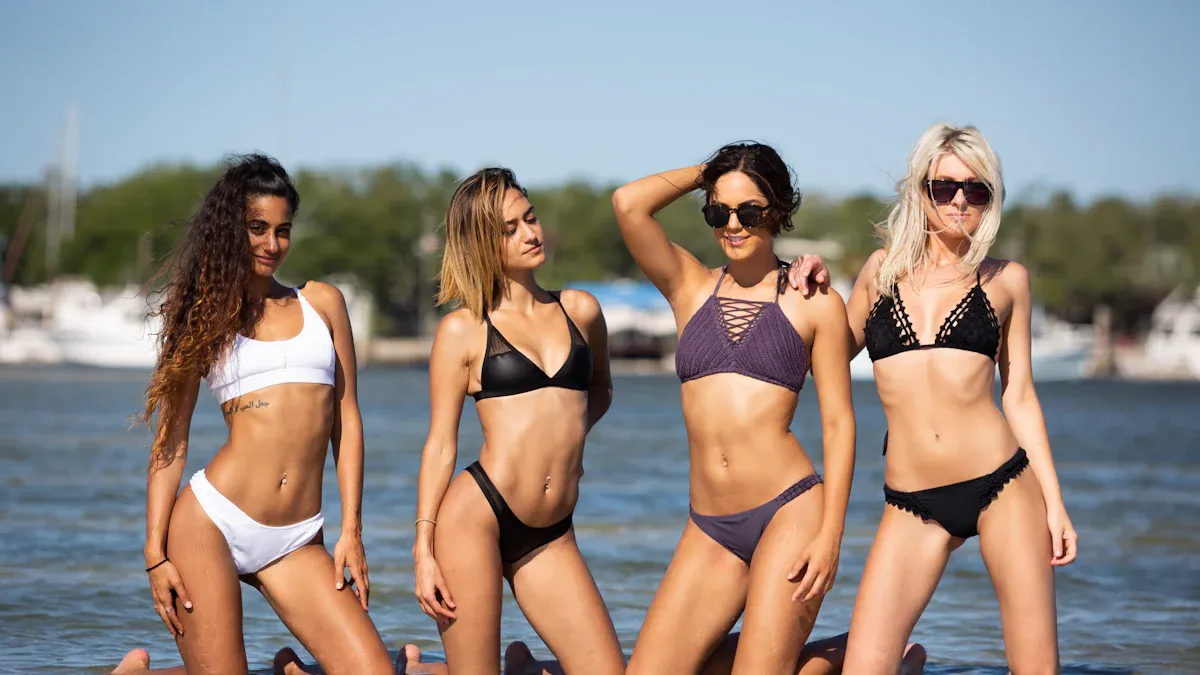
Last updated: 2026 – Content updated with recent industry data (2024–2026), revised medium-term projections, references to current certifications, and methodological recommendations aligned with current swimwear market standards.
Who is speaking?
This guide is written by a team specializing in the development and manufacturing of custom swimwear collections for international brands, active across several markets (Europe, North America). It combines updated field experience (sourcing, industrialization, quality control, sustainable materials) and a synthesis of market reports published by recognized third-party organizations.
Editorial Disclaimer (YMYL): This content is intended for educational and operational purposes. It does not replace personalized legal, financial, or tax advice. Before using market figures in a business plan, pitch deck, or bank application, always cross-reference multiple independent sources (market reports, professional association data, specialized press) and consult an accountant or specialized advisor as needed.
The data and examples cited are updated based on publications available up to 2026 and may evolve depending on economic, regulatory, and logistical conditions.
Sources & Market Data Methodology (2026 update)
Estimates for the global swimwear market vary according to each firm's methodology (product scope, distribution channels, exchange rates, geographical segmentation). In 2026, these discrepancies are amplified by the rapid evolution of e-commerce, recycled materials, and post-pandemic consumer behaviors.
Allied Market Research – Swimwear Market Report (market size, projections up to 2032).
Fortune Business Insights – Swimwear Market (market value 2024 and forecasts 2032).
The Business Research Company – Swimwear Global Market Report (growth and segmentation by type and fabric).
Textile Exchange – Materials Market Report (evolution of synthetic fibers, polyester, and recycled materials in textiles).
McKinsey & BoF – State of Fashion (macro trends in the fashion industry).
Important: The figures below are **orders of magnitude** derived from these reports. They serve to illustrate the overall dynamics of the sector. For a real business plan, use the complete reports directly and adapt the assumptions to your country, positioning, and product mix.
1. Understanding the Swimwear Market in 2026
Do you want to boost your swimwear line boutique and turn it into a coherent, desirable, and profitable brand? Before you start, it's useful to look at the evolution of the global swimwear market, not with a single “magic” figure, but with several scenarios from different sources.
By way of indication, several recent reports place the size of the global swimwear market at around 20–22 billion USD in the early 2020s, with an average annual growth of 4% to 7% by 2030–2033 (depending on the scope and methodology used).
Year / Horizon | Revenue (≈ Bn USD) | Source (example) |
|---|---|---|
2022 | ≈ 19.8 | Allied Market Research – Swimwear Market |
2024 | ≈ 21.2 | Fortune Business Insights – Swimwear Market |
2030–2033 (projection) | ≈ 30–45 | Various reports (Allied, Fortune, TBRC), CAGR ~4–7% |
These figures illustrate a trend: the swimwear market is experiencing moderate but steady growth, with strong sensitivity to materials, e-commerce, and travel trends. For your business plan, use quantified values directly extracted from the paid or free reports you have selected, and always note the year + source.
A coherent collection allows you to:
✔ differentiate yourself immediately,
✔ build a true brand identity,
✔ reassure and retain your customers through a consistent experience, from the first scroll to the unboxing.
Structuring Trends by 2026:
Customers expect comfort, inclusivity, transparency, and authentic storytelling. Brands performing in 2026 are not just selling swimsuits, but a clear vision of body, travel, and environmental responsibility, supported by concrete evidence (certifications, audits, traceability, customer reviews).
Key Points
Define your target market in a structured way (segment, persona, price, uses) using an STP framework (Segmentation – Targeting – Positioning), relying on data (Google searches, surveys, waiting lists, industry reports).
Propose 6 to 8 flagship models that cover key needs (sport, beach, plus-size, shaping, tanning, maternity…) and whose margin, inventory turnover, and return rate you track.
Highlight sustainability and traceability: certified materials, audited factories, clear social commitments, with label names and a dedicated explanatory page on your website.
Formalize your method: development process, checklists, decision matrices, manufacturer's specifications, and collection versioning (V1, V2, V3…).
Defining the Vision and Niche
Identify the Target Market with a Clear Method
To avoid launching a collection “for everyone” that speaks to no one, base your approach on a structured method. For example:
Segmentation: luxury, performance, eco-friendly, inclusive, shaping, maternity, competitive swimming, beach lifestyle…
Targeting: choose 1–2 main segments, no more (e.g., “urban young women aged 25–35, sensitive to eco-responsibility and active on Instagram”). Validate this choice with data: surveys, newsletter pre-registrations, waiting lists, sales page tests.
Positioning: define a clear positioning statement, such as:
“Brand X is a certified eco-comfort swimwear line, designed for active women who want to feel supported without compromising on style or manufacturing transparency.”
You can rely on:
Product category analyses (luxury, active, eco-responsible, inclusive…).
Audience studies (Google Trends, IG surveys, customer questionnaires) with a real sample (at least a few dozen responses).
Alignment with strong values: body confidence, slow fashion, athletic performance, minimalism, etc., indicating how they are concretely reflected in your products.
Tip: Write down the “central problem” your brand solves (e.g., “I can't find a comfortable, shaping swimsuit that doesn't look old-fashioned”). All your collection decisions should address this problem, and you can reiterate it in your storytelling.
Analyze the Competition with a Simple Grid
The swimwear market is evolving rapidly: growth of e-commerce, rise of recycled fabrics, key role of social networks. To position yourself, you can use a competitive analysis table:
Simplified Competitive Analysis Grid | |
Analysis Criteria | Questions to Ask |
|---|---|
Financial Evaluation | Profitable brand? Clear pricing strategy? Strong seasonality or spread-out sales? What gross margin levels are communicated or estimable? |
Brand Value | Lifestyle image, visual universe, body positive or ecological commitment? Is there proof: labels, CSR actions, collaborations? |
Acquisition Attractiveness | Collaborations, capsules, presence in the press / trade shows? Frequency of mentions in third-party media? |
Growth & Profits | Evolution of offer, turnover, collection launches? Stable growth or highly dependent on a one-off buzz? |
Leadership & Vision | New positioning? Eco-friendly shift? Diversification? Presence in interviews or conferences? |
Debt & Risks | Reliance on a single country of production, rising material costs, logistical delays? How do they manage crises (delays, stockouts, returns)? |
Resource Utilization | Sourcing quality, lead time control, management of leftover collections? Frequent liquidations or good replenishment management? |
Then complete this analysis by:
identifying key players: who dominates your segment?
studying their ranges (key pieces, prices, materials, sizes offered).
analyzing their marketing: social networks, storytelling, UGC, loyalty programs.
understanding their purchasing journey: customer reviews, return management, delivery times.
Define a Differentiating and Credible Concept
A good concept relies on a focused and credible positioning. For example, Arena positions itself as a specialist in high-end swimming: performance, quality, professional sports universe.
You can draw inspiration from this logic by asking yourself 3 questions:
Function: Is your swimsuit designed for sport, beach, intensive swimming, wellness, maternity…?
Emotion: Does your universe speak of power, softness, holidays, self-confidence?
Responsibility: How do you position yourself on materials, production, inclusivity?
Goal: To be able to summarize your concept in a clear sentence that you can display on your home page, packaging, Instagram, and funding application.
Designing a Coherent Collection
 Image Source: pexels
Develop a Strong Guiding Thread
To avoid a “soulless catalog” effect, build your collection around a clear guiding thread:
In-depth research: color charts, prints, key cuts, expectations (comfort, support, coverage…).
Brand DNA: list 5 keywords that summarize your universe (e.g., “eco-luxury”, “Mediterranean”, “athletic”, “minimalist”, “sensory”).
Palette: 2 pillar colors + 2 secondary + 1 accent for the entire collection.
Shape balance: 1-piece, 2-pieces, bandeau, triangle, high-waist briefs… consistent with your positioning.
Storyboard: imagine your silhouettes in real life (on the beach, at the pool, on vacation…).
Solid storytelling helps increase add-to-cart rates and brand memorability, even with few references. Validate your visual universe with a small panel of target customers before launching full production.
Create Unique & Mix-and-Match Styles
Mix-and-match has become an expected standard: combinable tops and bottoms, differentiated sizes, complementary colors. To structure your offer, you can:
offer sporty and feminine cuts in parallel,
play with open backs, high-cut hips, and long leg openings,
integrate adjustable or criss-cross straps for tailored support,
choose technical fabrics (such as H²Infinity recycled polyester, or certified equivalents).
Concrete advantages of mix-and-match:
better freedom of movement and adaptation to every body shape,
more even tan,
multiplication of looks with few pieces.
Select 6 to 8 Flagship Models
There's no need to release 30 references: a strategy inspired by Sézane capsules (limited collections) shows that a short and desirable offering works better.
6 to 8 targeted models = more clarity for the customer + less dead stock + stronger storytelling.
Materials and Quality Production
Choose Suitable and Durable Materials
For swimwear, the main technical criteria are: elasticity, recovery (stretch recovery), chlorine/UV resistance, comfort on wet skin, and drying.
Elastane (Lycra®): highly stretchable, provides comfort and support, sensitive to excessive heat.
Nylon (polyamide): quick-drying, soft touch, good elasticity.
Polyester: excellent resistance to chlorine and UV, durable colors.
Recycled fabrics (e.g., yarns from fishing nets or textile waste): better brand image and strong ecological argument, especially when certified.
You can compare your options with a simple table:
Simplified Comparison of Main Swimsuit Materials | |||
Material | Chlorine/UV Resistance | Comfort | Eco-responsibility |
|---|---|---|---|
Polyester + Elastane | High | High | Medium to High (if recycled) |
Nylon + Elastane | Medium | Very High | Variable (depends on sourcing) |
Certified Recycled Fabrics | High | High | High (according to GRS, etc., labels) |
Regarding certifications, prioritize:
Oeko-Tex Standard 100 to limit harmful substances,
ISO 9001 for quality management,
Global Recycled Standard (GRS) for tracing recycled materials,
potentially ISO 14001 for environmental management if your manufacturer offers it.
Good practice: Systematically request up-to-date certificates (less than 12 months old) and verify their validity on the official organizations' websites or in public databases.
Select Reliable Manufacturers
A “good” manufacturer is not just the cheapest, but one who combines:
quality labels and transparency on processes,
ability to work with technical materials (recycled fabrics, high grammage),
fair working conditions, as detailed in some quality charters,
clear quality control protocols (color fastness tests, seam resistance, measurement control).
Quick checklist to qualify a manufacturer:
Can they produce in the grammages and blends you target?
Do they accept a first order with a reasonable MOQ?
Do they offer a written typical schedule (proto – pre-prod – prod – QC – shipping)?
Do they provide you with workshop photos/videos, certificates, and test reports?
Test and Adjust Prototypes
Before validating a model, always go through a complete prototyping cycle:
digital pattern making to optimize size grading,
physical prototype to check the fit and feel on the body,
color fastness tests (chlorinated water, salt water, UV), ideally according to standards like ISO 105,
morphological tests on several body types (large bust, wide hips, defined waist, etc.).
Never validate a model without at least a cumulative 24–48 h wear cycle (pool, sea, drying, repeated dressing). Document these tests (photos, spec sheets, user feedback) for your internal quality control.
Strong Brand Identity
Create a Credible Brand Story
A good brand story isn't limited to “I love the sea.” Lasting brands structure their narrative around:
a clear commitment (ecology, well-being, athletic performance, local production…),
a point of view on the body (body positive, inclusion, modesty, sensuality…),
evidence: recycled materials, audited factory, concrete actions, inclusive campaigns…
For example, some brands like Banana Moon have captivated with ECONYL® collections, while others focus on highly immersive universes (vacations, surfing, getaways).
Develop a Coherent Visual Identity
To be recognizable:
create moodboards for each collection,
develop recurring patterns/signatures (stripes, stylized flowers, a recognizable shade of blue…),
organize photoshoots that highlight body and situational diversity (pool, beach, boat, rooftop…).
Harmonize All Media
Your website, Instagram, TikTok, PDF lookbooks, and mailings must tell the same story:
same color palette,
same tone of voice (friendly, expert, activist, glamorous…),
same emphasis on key values (durability, comfort, performance, etc.).
Launch and Promote Your Swimwear Line Boutique
Social Media Strategy
Social media is often the first storefront for a swimwear brand. You can:
post short Reels (4–7 seconds) showing the swimsuit in motion (jumping into water, swimming, walking on the beach),
publish behind-the-scenes of your development (fabric selection, prototyping, testing),
show “real try-ons” on various body types,
organize contests to generate UGC (User Generated Content).
Engagement (comments, shares, saves) is often more predictive of sales than the mere number of followers. Track your KPIs (CTR, reach, save rate) to adjust your editorial line.
Collaborations and Influencers
Well-chosen collaborations can accelerate your notoriety. For example:
Noholita's collaborations with Mon Petit Bikini
Advantages:
direct access to engaged communities,
social validation of quality and style,
“limited capsule” effect that enhances purchase urgency.
Highlight Your Collection's Strengths
Summary of Key Product Strengths | |
Strengths | Description |
|---|---|
Durable Fabrics | Resistant to chlorine and salt, retain their colors for several seasons. |
Modular Styles | Mix-and-match, differentiated top/bottom sizes, possibility to create multiple looks. |
Optimal Comfort | Cuts adapted to various body shapes, adjustable straps, comfortable linings. |
Lean on your brand's values (durability, inclusivity, performance…) and concretely show how they translate into your products (materials, cuts, sizes, prices).
Differentiation & Inclusivity
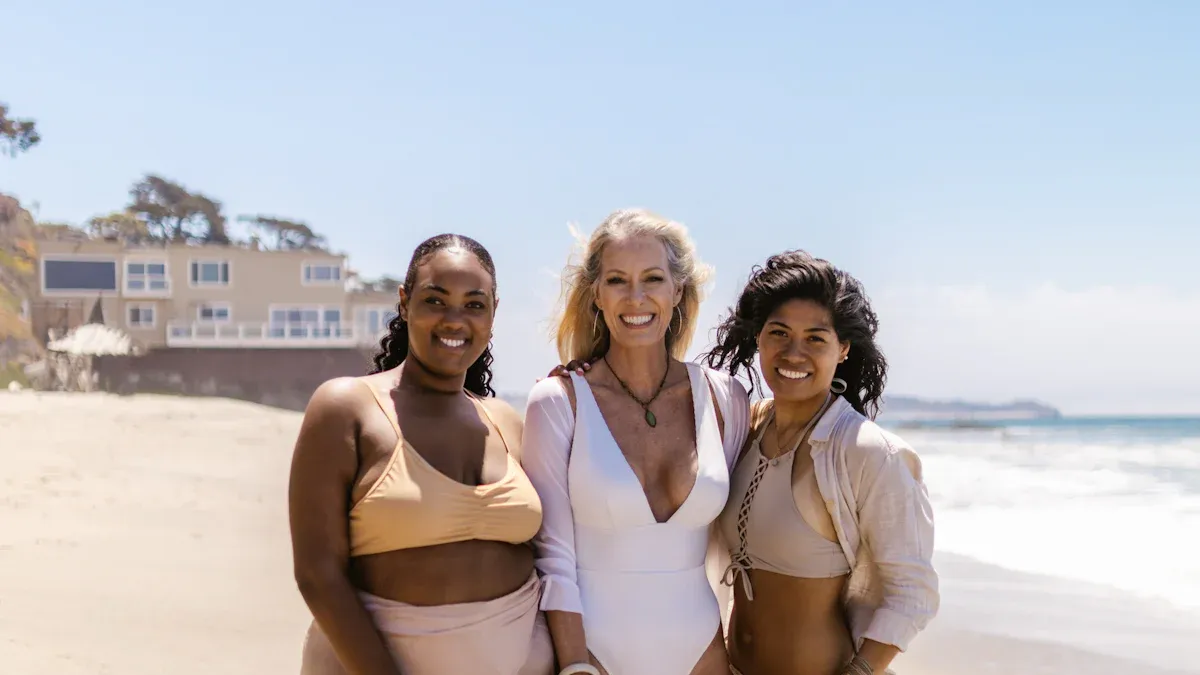 Image Source: pexels
Offer Models for All Body Types
Brands like Peony or Lolo Paris are making progress by showcasing body diversity in their campaigns.
Examples of Inclusive Initiatives | ||
Initiative | Impact | Example |
|---|---|---|
Inclusive Campaigns | Changes body perception, improves brand identification. | Collaboration with body positivity organizations. |
Advertising Regulations | Encourage more authentic and varied representations. | Standards encouraging the inclusion of different body types. |
Inclusive Fashion Shows | Increase visibility of diversity and brand credibility. | Shows featuring models of all sizes and ages. |
Emphasize Sustainability
To make your ecological discourse credible:
explain the origin of your materials (recycled, certified…),
present your labels (Oeko-Tex, GRS, ISO) and what they truly guarantee,
give care tips to extend the lifespan of swimsuits.
Address Specific Needs
Some customers are looking for:
reinforced support (large busts, intensive sport),
more modest cuts (culture, modesty, sun protection),
anti-UV fabrics,
more inclusive sizes (from XS to 3XL or more).
Inclusive fashion creates a strong emotional connection: customers feel seen, respected, and represented, which increases brand loyalty.
Practical Tools & Templates (to be transformed into downloadable resources)
Checklist: Swimwear Collection Development
✔ Target market defined (segment + persona + expected average price).
✔ Brand concept formulated in a clear sentence.
✔ Color palette + visual universe validated.
✔ 6–8 flagship models selected with precise objectives (sport, beach, plus-size…).
✔ Materials chosen + certifications identified (Oeko-Tex, GRS, ISO…).
✔ Qualified manufacturer (MOQ, lead times, certifications, client references).
✔ Prototypes tested on multiple body types.
✔ Social media strategy + launch plan defined.
Quick Positioning Matrix
Simple Price x Use Positioning Matrix | ||
Accessible Price | Premium Price | |
|---|---|---|
Daily Use / Leisure | Affordable “beach & vacation” swimwear | Eco-luxury, signature design |
Sport / Performance Use | Functional athletic basics | High-end technical swimwear (competition, swimming) |
Simplified Manufacturer Specifications Example
Brand info: positioning, target, sales countries.
Collection: number of models, sizes, grading.
Materials: composition, grammage, expected certifications.
Manufacturing: stitch type, finishes, linings.
Tests: chlorine/UV resistance, color fastness, stretch.
Lead times: proto, pre-series, production, shipping.
MOQ & pricing: minimum quantities, volume-based pricing structure.
Mini Glossary: Understanding Key Terms
CAGR (Compound Annual Growth Rate)
The average annual growth rate of an indicator (revenue, volume) over several years. Useful for comparing market scenarios.
Gross Margin
The difference between the selling price and the cost of goods sold (materials, manufacturing, transport…) before marketing and overhead costs.
Inventory Turnover
The speed at which your inventory sells over a given period. Healthy turnover limits immobilized stock and markdowns.
MOQ (Minimum Order Quantity)
The minimum quantity per model/color/size required by the manufacturer to start production.
PFM / Preferred Materials
Term used by Textile Exchange to designate fibers and materials with reduced impact (recycled, bio-based, etc.).
FAQ
How do I choose the right fabric for my swimwear?
Prioritize polyester/elastane or nylon/elastane blends suited to the intended use (pool, sea, sport, beach). If possible, opt for certified recycled materials (GRS, Oeko-Tex). Ask your supplier for technical data sheets specifying chlorine resistance, UV resistance, and elastic recovery, ideally with reference to the tests used (e.g., ISO 105 for color fastness).
How many models should I launch to start?
You can start with 6 to 8 flagship models: this is enough to cover several needs (beach, sport, plus-size, shaping, basics) while maintaining controlled logistics and inventory management. The coherence of the collection is more important than the number of references.
Should I offer inclusive sizing from launch?
Ideally, yes. Offering a wider size range from the outset (e.g., from XS to XXL, or more) shows that your brand genuinely cares about inclusivity. If this isn't possible, clearly announce your plan to expand sizing in the second or third collection and gather pre-registrations to prioritize the most requested sizes.
How can I make my market forecasts more credible?
Always rely on multiple sources (professional articles, industry studies, specialized press data) and specify the year of each estimate. Present growth figures as trends or scenarios, mentioning that forecasts may evolve depending on the economic climate, material costs, and changes in consumer behavior. Indicate the document's update date and plan for an annual review.
Transparency & Commercial Interests
This guide is published by a company that offers swimwear collection development and manufacturing services for B2B brands. Our interest is to help you structure a solid project, whether you choose to work with us or with another partner. We encourage you to compare several manufacturers, quotes, and business models before committing.
Links to other brands or media (blogs, boutiques, collaboration examples) are provided for inspiration. They do not constitute official validation of their practices or a source of financial data.
Final Note: This guide aims to help you structure your project professionally and transparently. For any decision strongly committing your capital (investment, credit, distribution contract), do not hesitate to consult an accountant, a lawyer, or a specialized advisor in fashion and textiles.This guide was updated in 2026 and is subject to annual review to remain aligned with market evolutions and regulations.