SEO title: China vs Bali vs Brazil: Best Place to Manufacture Swimwear in 2026
Meta description: Compare swimwear manufacturing in China, Bali, Brazil, Vietnam, Europe, and the USA by cost, MOQ, fabrics, lead time, and certification readiness.
Choosing where to manufacture your swimwear line in 2026 is not simply a choice between a low price and a premium product. The right location depends on your launch volume, target retail price, product complexity, fabric strategy, compliance requirements, replenishment model, and the amount of development support your team needs.
From our perspective as a China-based custom swimwear factory, the most useful comparison is not “Which country is cheapest?” It is “Which supply base can deliver the required product, at the required volume and compliance level, without creating hidden development, quality, or inventory costs?”
For most growing brands, China offers the strongest overall balance of cost, MOQ flexibility, material access, speed, customization, and scalability. Bali is attractive for boutique positioning and hands-on small-batch development. Brazil is compelling for authentic beachwear design and distinctive fit. Vietnam performs well for stable, larger-volume programs. Europe and the USA are strongest when proximity, premium positioning, and regional production carry more weight than unit price.
Important scope note: The figures below are realistic 2026 planning ranges, not universal quotations. They assume a fully lined women’s bikini set in standard nylon-spandex or polyester-spandex, with one straightforward solid color or print, standard labels, and individual packaging. Underwire, molded cups, bonded seams, custom hardware, embroidery, complex prints, custom-milled fabric, extended sizing, testing, freight, duty, and tax can materially change the result.
2026 Swimwear Manufacturing Comparison at a Glance
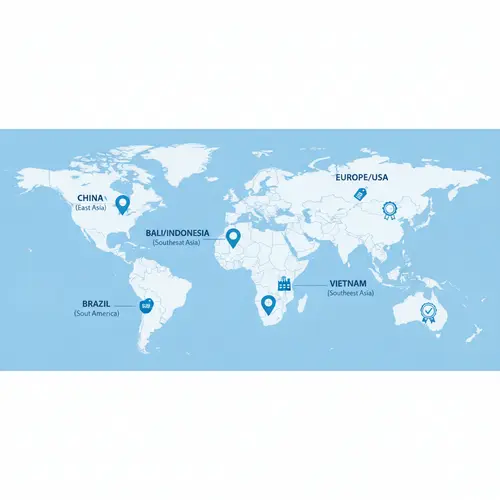
The following table compares five mainstream sourcing regions from a brand buyer’s perspective. “Practical custom MOQ” means a quantity that a suitable specialist factory may genuinely accept for a customized style—not a promotional minimum that applies only to blank products, stock designs, or a single sample.
Manufacturing region | Indicative ex-factory cost* | Practical custom MOQ | Typical first-order timeline** | Fabric and trim access | Certification readiness | Best suited to | Main trade-off |
|---|---|---|---|---|---|---|---|
China | USD 8–18 per set | 50–300 units per style/color at flexible specialists; 300–1,000+ for stronger pricing | 6–10 weeks plus freight | Excellent: broad stock and custom fabrics, linings, elastics, cups, hardware, labels, packaging, and printing | High among established export factories; broad access to certified materials and social-compliance programs | Startups, growing DTC brands, private label, OEM/ODM, technical products, and scalable collections | Supplier capability varies widely, so factory verification and specification control are essential |
Bali / Indonesia | USD 18–35 per set | 50–200 units per style; lower quantities may apply to ready-label programs | 8–14 weeks plus freight | Good for curated sustainable options, but many premium fabrics and components are imported | Moderate; strong sustainability storytelling, but formal audit scope varies by workshop | Boutique labels, resort brands, capsule collections, and lifestyle-led launches | Higher unit cost, smaller capacity, imported inputs, and greater scheduling sensitivity |
Brazil | USD 16–32 per set | 100–300 units per custom style; selected white-label programs may start lower | 12–18 weeks plus freight | Strong local beachwear fabrics, prints, shaping knowledge, and signature trims | Moderate; good material innovation, but documentation must be checked program by program | Brands seeking Brazilian fit, bold prints, and authentic beachwear identity | Longer custom-production cycle and less consolidated international sourcing than China |
Vietnam | USD 9–20 per set | 300–1,000 units per style commonly; approximately 100–500 at selected studios | 13–17 weeks, often around 90–120 days for a first order | Good for performance knits and export production, but the specialist swimwear supplier pool is narrower | High at larger export factories; less consistent among small studios | Established brands with stable specifications and repeatable medium-to-large orders | Higher effective MOQ and a slower, less flexible development cycle |
Europe / USA | USD 24–60 per set | 30–150 units at small studios; 100–300 is more common for full custom work | 8–16 weeks; freight can be short for local markets | Excellent premium fabric access in parts of Europe; US sourcing varies and may rely on imported inputs | High regulatory familiarity; certification availability depends on the mill and factory | Premium brands, local-made positioning, rapid regional replenishment, and high retail margins | Highest labor and overhead cost, with limited savings from scale at smaller facilities |
* Excludes development fees, samples, testing, freight, duty, tax, and unusual components.
** From a usable tech pack to completed goods under normal scheduling. Additional fit rounds or custom-milled fabric extend the calendar.
What Actually Makes Up the Cost of a Swimsuit?
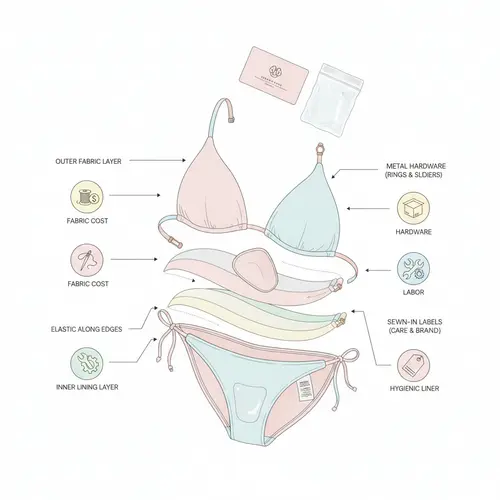
A low quotation does not always produce the lowest landed cost. Swimwear is technically demanding: stretch recovery, lining behavior, elastic tension, seam durability, colorfastness, print placement, cup stability, and fit all interact. A factory that underestimates development or substitutes an unsuitable material may create expensive revisions, returns, or missed launch dates.
Cost element | China | Bali | Brazil | Vietnam | Europe / USA |
|---|---|---|---|---|---|
Main fabric and lining | Competitive because of broad regional supply and stock availability | Frequently premium-priced, especially when branded recycled fabrics are imported | Strong local options; specialty Brazilian fabrics can carry a premium | Competitive at volume, but lower-volume sourcing can be restrictive | Premium Italian, Portuguese, or local materials are expensive; US programs may use imported fabric |
Labor and factory overhead | Low to medium, depending on factory level and construction complexity | Medium to high because of smaller-batch production and workshop economics | Medium, with skilled beachwear labor priced above mass Asian production | Low to medium, particularly efficient at stable volume | High to very high |
Pattern, sampling, and setup | Efficient when pattern, printing, trims, and production are coordinated by one supplier | More hands-on service, but fixed development cost is spread over small orders | Strong fit development, especially for Brazilian silhouettes; custom work takes time | Efficient for confirmed programs, less economical for repeated small revisions | High hourly development cost, although communication and proximity may reduce iteration risk |
Labels, hardware, cups, and packaging | Broadest choice and usually the best consolidated pricing | Curated choice; some components require import or higher minimums | Good decorative identity, but international buyers may have fewer one-stop options | Good for established programs; specialist choices depend on the factory network | Premium options are available, but small-quantity components are costly |
Logistics effect | Competitive sea freight at volume; air freight is useful for samples and urgent launches | Island logistics and imported inputs can add time and cost | Export distance can be significant for North American, European, and Asian buyers | Efficient export infrastructure, but long first-order development reduces speed | Lowest freight time when production and customers are in the same region |
For a brand, the correct comparison is total landed and operational cost: development, sample rounds, bulk goods, quality control, packaging, freight, import charges, communication time, defect exposure, and the cash tied up in inventory. A USD 2 saving at the factory level can disappear quickly if the order requires an extra sample round, expensive air freight, or rework after delivery.
Manufacturing Swimwear in China: Best All-Round Supply Chain for OEM/ODM
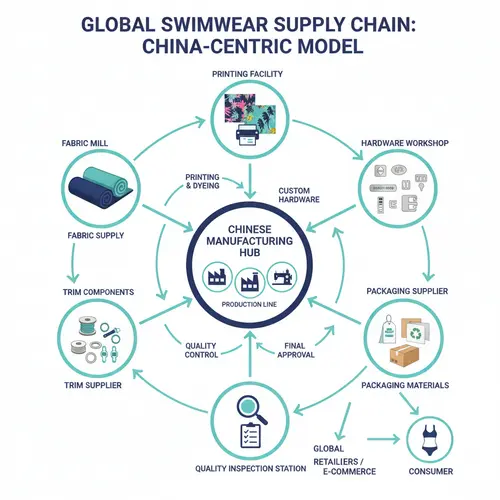
China remains the most complete option for brands that want to combine custom development with commercial pricing. The main advantage is not labor alone. It is the density of the supply chain. A capable swimwear manufacturer can coordinate fabric, lining, elastic, thread, removable or molded cups, underwire, sliders and rings, custom metal hardware, heat-transfer labels, hangtags, hygienic liners, packaging, and several print processes without building a separate vendor network for every component.
This matters when a collection contains more than basic triangle bikinis. High-waisted bottoms, supportive one-pieces, long-torso fits, rash guards, textured fabrics, reversible products, maternity swimwear, kids’ swimwear, extended sizing, and technical resort products all require different combinations of pattern engineering and components.
From the RFQs we see at factory level, a realistic low MOQ for custom swimwear in China is commonly 50–300 units per style or color when the brand uses available fabrics and standard components. The lowest end normally requires simple construction, flexible size splits, and compatible fabric choices. Custom-dyed fabric, exclusive jacquards, special hardware, or a wide color assortment can push the effective MOQ much higher. For proven styles, moving to 300–1,000 units usually improves fabric utilization, line efficiency, and unit cost.
A straightforward sample can often be developed in one to three weeks, while bulk production commonly requires four to seven weeks after approval and material readiness. A well-prepared first order can therefore be completed in approximately six to ten weeks before international freight. Peak-season capacity, multiple fit rounds, and custom materials must be added to the schedule.
China is especially suitable when a brand needs OEM and ODM support. Under OEM, the factory develops and produces from the buyer’s tech pack and approved specifications. Under ODM, the manufacturer can support design direction, material recommendations, pattern adaptation, colorways, print application, and collection development. Many emerging brands use a hybrid model: they provide the brand concept and fit target, while the factory turns it into production-ready specifications.
The trade-off is supplier inconsistency. “Made in China” does not describe one capability level. A low-cost trading company, a general activewear factory, and a specialized swimwear manufacturer may all present similar product photos while offering very different control over patterns, elastic application, fabric testing, and quality assurance. Buyers should verify where sampling and bulk production occur, who owns the pattern files, how materials are approved, and which inspection standard will be used.
Manufacturing Swimwear in Bali: Boutique-Friendly but Not Automatically Low Cost
Bali has a strong reputation among startup swimwear founders because its manufacturing story aligns naturally with resort culture, ethical production, small collections, and sustainable branding. Some suppliers offer ready designs, white-label programs, flexible color and size splits, or low-volume custom development. That makes Bali accessible for a founder testing a tightly edited capsule.
However, low MOQ does not mean low unit cost. Small production runs carry more pattern, cutting, setup, and project-management cost per piece. Premium recycled fabrics such as ECONYL or REPREVE may be imported, and specialty hardware or packaging can also come from outside the island. The resulting cost can be appropriate for a premium DTC brand, but difficult for a business competing at a mid-market retail price.
A practical planning range is 50–200 units per custom style, with lower entry quantities more likely when a brand selects existing patterns or a white-label collection. Development may take two to four weeks, and bulk production commonly takes six to ten weeks after approval. Capacity is more sensitive to season and workshop size than in China’s larger production clusters.
Bali is a strong choice when the brand values an intimate development process, a resort-led identity, and limited seasonal drops. It is less ideal when the collection requires many custom components, rapid scale-up, very aggressive pricing, or complex technical construction across a large size range.
Manufacturing Swimwear in Brazil: Authentic Fit and Beachwear Design
Brazil offers something difficult to reproduce through sourcing alone: a mature beach culture with recognizable fit, shaping, color, and print sensibility. Brazilian factories can be especially strong in flattering bottom cuts, sculpted silhouettes, bold combinations, decorative details, and locally developed beachwear fabrics.
For a fully customized private-label project, a realistic starting point is often approximately 100–300 units per style. Some white-label programs can begin lower because the patterns and material combinations already exist. A public ready-label minimum should therefore not be confused with the MOQ for a completely original pattern, print, and construction.
Custom Brazilian production can require about 10–12 weeks after development, with the overall first-order process commonly reaching 12–18 weeks once prototyping, fit approval, scheduling, and export preparation are included. Brands should also confirm whether prices are ex-works, whether export documentation is included, and how replacement or rework will be handled across borders.
Brazil is a compelling option for a brand whose product value comes from a genuine Brazilian aesthetic and fit story. It is less attractive when the priority is one-stop sourcing across dozens of fabrics, technical trims, packaging formats, and rapid volume scaling.
Manufacturing Swimwear in Vietnam: Efficient for Stable Volume
Vietnam has a strong export-apparel industry and can deliver disciplined production, particularly for brands with established specifications and repeat demand. Its swimwear sector, however, should not be confused with its much broader T-shirt, cut-and-sew, or general activewear base. Swimwear requires specialist knowledge of stretch, lining, elastic tension, chlorine or saltwater exposure, and fit.
Established swimwear factories commonly work at 300–1,000 pieces per style or color, while selected smaller studios may accept around 100–500. Large export-oriented facilities may require 1,500–3,000 pieces or more, especially when the product uses custom materials. This makes Vietnam less suitable for an early brand launching many unproven designs in small quantities.
A realistic first-order process can take 90–120 days from tech pack to shipment. Fabric and color development may require two to three weeks, fit and pre-production sampling another two to three weeks, bulk manufacturing approximately eight to eleven weeks, and final inspection and packing additional time. Repeat orders on approved patterns can be faster.
Vietnam is most competitive when the buyer has clean technical files, stable forecasts, a controlled material list, and enough volume to reserve capacity. For frequent design changes or a high style count with small quantities, China generally offers more flexible supplier coordination.
Manufacturing Swimwear in Europe or the USA: Premium Positioning and Proximity
“Europe and the USA” cover very different production ecosystems. Portugal and Italy are known for premium textiles, technical expertise, and European brand proximity. Los Angeles, Miami, and other US production centers can support domestic-made positioning, direct communication, and fast replenishment for local sales. Their shared limitation is cost.
Small studios may accept 30–150 units, but a sustainable custom program more commonly begins around 100–300 units once fabric and trim minimums are considered. Ex-factory cost can range from USD 24 to USD 60 per set, and technically complex products can go higher. A low sewing MOQ does not remove a fabric mill’s minimum, dye-lot requirement, or the fixed cost of pattern and grading work.
European development often emphasizes precise pattern work, premium finishing, and access to Italian or regional performance fabrics. US production can shorten domestic transport and make in-person fit review easier. These advantages are commercially meaningful for a premium brand with sufficient retail margin.
Europe or the USA is therefore a rational choice when “locally made,” speed to the regional customer, or premium provenance supports a higher selling price. It is usually not the best choice for price-sensitive wholesale, large style assortments, or a brand that needs both low MOQ and low unit cost.
MOQ Flexibility: Compare the Conditions, Not Just the Number
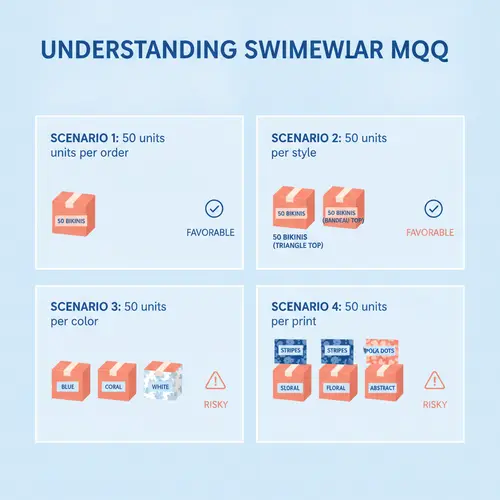
MOQ is frequently misunderstood because it can apply per order, style, color, print, fabric, or size run. A supplier advertising “MOQ 50” may mean 50 units of one stock design in one fabric. A custom order with four styles, three colors, and six sizes could trigger a very different minimum.
Question to ask | Why it changes the real MOQ |
|---|---|
Is the minimum per order, style, color, or print? | A 100-piece order can become 100 pieces for every color if the definition is unclear |
Can sizes be mixed freely? | Balanced size ratios reduce inventory risk, especially for new brands |
Must the fabric be stock, or can it be custom dyed? | Custom colors and exclusive textiles usually have mill-level minimums |
Does the MOQ include both bikini tops and bottoms? | Separates may be counted as individual pieces rather than complete sets |
Are labels, cups, hardware, and packaging subject to separate minimums? | Component MOQs can be higher than the sewing MOQ |
Is low MOQ available for original patterns or only ready designs? | White label and full custom private label are different production models |
For a launch collection, fewer styles with deeper quantity usually produce better pricing and more reliable quality than many styles at the absolute minimum. A factory can also improve flexibility by sharing one approved fabric across several designs, standardizing hardware, and using a controlled color palette.
Fabric Supply: Where China Has the Clearest Structural Advantage
Swimwear fabric is not interchangeable with ordinary stretch fabric. The material must be evaluated for stretch and recovery, opacity when wet, pilling, dimensional stability, colorfastness, print performance, UV exposure, chlorine or saltwater conditions, and compatibility with lining and elastic.
Region | Fabric strengths | Typical limitation |
|---|---|---|
China | Broad nylon-spandex and polyester-spandex ranges; recycled yarns; rib, crinkle, jacquard, shine, matte, compression, mesh, and lining options; multiple print methods | The buyer must control specifications to prevent unapproved substitutions |
Bali | Curated sustainable fabrics and resort-focused textures; good brand storytelling | Imported branded fabrics increase cost, lead time, and material minimum exposure |
Brazil | Strong local beachwear textiles, prints, biodegradable or lower-impact innovations, and shaping fabrics | International certification paperwork and repeat color availability must be confirmed |
Vietnam | Good performance knits for volume programs and access to regional mills | Fewer low-MOQ swimwear specialists and less flexibility for experimental material sourcing |
Europe / USA | Premium Italian and Portuguese fabrics, advanced finishes, strong tactile quality | High price; small brands may struggle with mill minimums, while US makers may still import fabric |
From a China factory’s point of view, the advantage is the ability to compare several material solutions against the same design and target price. A brand can begin with a reliable stock fabric, validate the fit and sales, then move into an exclusive color, texture, or recycled option as volume grows. This staged sourcing strategy protects cash while preserving a path toward differentiation.
Certification and Compliance: Ask for Scope, Not a Logo List
Certification capability belongs to a specific material, process, facility, and validity period—not to an entire country. A factory may pass a social audit while the selected fabric is not certified. A fabric supplier may hold a recycled-content certification while the sewing facility is outside the transaction chain required for a particular claim.
Established export factories in China and Vietnam often have the broadest access to programs such as OEKO-TEX Standard 100, GRS, RCS, amfori BSCI, Sedex/SMETA, WRAP, ISO 9001, and ISO 14001, depending on the facility and customer base. Bali and Brazil can provide credible sustainable materials and ethical production, but small workshops may have fewer formal audits. European and US suppliers usually understand regional chemical, labeling, labor, and product-safety expectations well, although third-party certification still varies by supplier.
Brands should request the certificate number, certified company name, product scope, facility address, issue and expiry dates, and—where relevant—transaction documentation. They should also distinguish between product safety, recycled content, chemical management, quality systems, environmental management, and social compliance. These are different claims.
GOTS is another common source of confusion. It is relevant to qualifying organic textile products, but conventional nylon-spandex swimwear is not automatically a GOTS product. For recycled synthetic swimwear, GRS or RCS documentation may be more relevant, while OEKO-TEX can support testing for harmful substances. Claims should match the actual material and chain of custody.
Lead Time: The Fastest Sewing Quote Is Not Always the Fastest Launch
A factory may quote four weeks for bulk sewing, but that does not mean the collection will ship four weeks after the first email. Product development begins with specifications, pattern work, fabric and trim confirmation, sampling, fit review, revisions, size grading, pre-production approval, material booking, and production scheduling.
Project stage | Efficient planning target |
|---|---|
Tech pack and quotation alignment | 3–7 business days |
Fabric, color, print, and trim confirmation | 1–3 weeks |
First prototype | 1–4 weeks, depending on region and complexity |
Fit revisions and pre-production sample | 1–4 additional weeks |
Bulk material preparation | 1–5 weeks; longer for custom-milled fabric |
Cutting, sewing, finishing, and inspection | 4–12 weeks by region and order size |
Freight | Several days by express/air or several weeks by sea |
For a seasonal launch, brands should work backward from the warehouse date, not the campaign date. Include time for incoming inspection, photography, content creation, retailer delivery windows, and a contingency buffer. Reorders are faster when the original pattern, bill of materials, color standard, print file, and inspection criteria are properly controlled.
Which Manufacturing Location Is Best for Your Swimwear Brand?
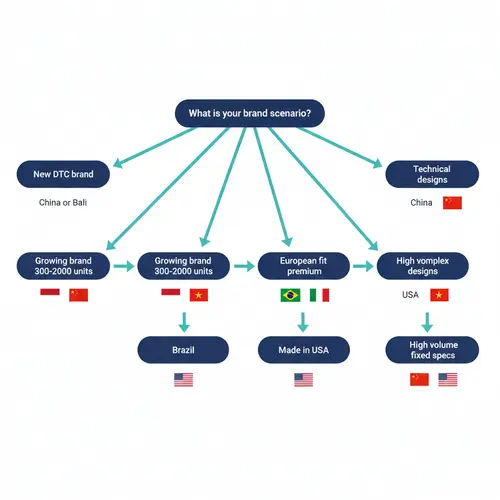
There is no single winner for every business model. The best location is the one that protects the brand’s most important constraint.
Brand scenario | Best starting option | Reason |
|---|---|---|
New DTC brand needing original designs and controlled risk | China or Bali | China offers a stronger cost-to-customization balance; Bali suits a smaller premium resort capsule |
Growing brand needing 300–2,000 units per style | China or Vietnam | China is more flexible across styles and components; Vietnam is efficient for stable repeat programs |
Premium label built around Brazilian fit and identity | Brazil | Product authenticity and local beachwear expertise support the brand proposition |
European premium brand prioritizing regional sourcing | Portugal or Italy | Proximity, fabric heritage, and premium finishing can justify the price |
US brand needing domestic replenishment and a “Made in USA” story | USA | Short regional logistics and direct communication may outweigh labor cost |
Brand with technical designs, many trims, and future scaling plans | China | The consolidated fabric, component, printing, packaging, and production network reduces coordination risk |
High-volume program with fixed specifications and long-range forecasts | China or Vietnam | Both can deliver export-scale production; supplier selection depends on MOQ, material plan, and capacity |
For most B2B buyers seeking custom swimwear, private label production, OEM/ODM development, and a scalable long-term supply chain, China is the most balanced choice in 2026. It is rarely the absolute cheapest at every specification, and it should not be selected without due diligence. Its advantage is that cost, flexibility, speed, material breadth, customization, and certification access can be optimized within one sourcing ecosystem.
How to Request a Comparable Swimwear Manufacturing Quote
A professional quotation should be based on the same information across every country. Otherwise, one supplier may quote a stock fabric and basic construction while another includes premium lining, custom hardware, and testing. The numbers will look comparable but describe different products.
Send each candidate factory a package containing the tech pack or clear reference design, target fabric composition and weight, color or print requirements, size range, quantity by style and color, construction details, cup and hardware requirements, label and packaging specifications, target market, required tests or certifications, desired delivery date, and shipping destination.
From our factory-side perspective, the most efficient RFQs also include a target wholesale or retail price. This does not invite arbitrary pricing; it helps the development team recommend a workable material and construction route. If the target is unrealistic, it is better to identify the gap before sampling than after several weeks of development.
Final Verdict: China Offers the Best Balance for Most Growing Brands
Bali, Brazil, Vietnam, Europe, and the USA each offer a legitimate strategic advantage. Bali is strong for boutique resort positioning. Brazil brings authentic beachwear design. Vietnam rewards stable volume. Europe delivers premium craft and material heritage. The USA provides regional proximity and domestic-made value.
For most startups and growing swimwear brands, however, China remains the strongest all-round manufacturing base in 2026. A specialized Chinese swimwear factory can support low-to-medium MOQs, complex customization, broad fabric and trim sourcing, custom printing, packaging, certification programs, and a clear path from first capsule to commercial scale.
The winning sourcing decision is not about selecting a flag. It is about selecting a partner whose development process, material controls, MOQ structure, quality system, and production capacity fit your business model.
Start Your Custom Swimwear Project
If you are planning a new swimwear line, expanding an existing collection, or looking for a more capable production partner, we provide B2B custom swimwear manufacturing, private label services, OEM production, ODM development, sampling, fabric and trim sourcing, branding, packaging, and long-term brand collaboration.
Send us your tech pack, sketches, reference samples, target quantity, size range, launch date, destination market, and certification requirements. Our team can review the project, recommend a practical material and construction route, confirm the workable MOQ, and prepare a transparent development and production quotation.
Contact us to discuss your custom swimwear, OEM/ODM, private label, or brand partnership project for 2026.
Frequently Asked Questions
1. What is the best country to manufacture swimwear in 2026?
For most startups and growing brands, China offers the best overall balance of unit cost, low-to-medium MOQ flexibility, fabric access, customization, lead time, and scalability. Bali can be better for boutique resort collections, Brazil for an authentic Brazilian fit and design identity, Vietnam for stable higher-volume programs, and Europe or the USA for premium regional production.
2. What is a realistic MOQ for custom swimwear?
A realistic MOQ depends on whether the project uses an original pattern, a stock design, available fabric, or a custom-developed material. In China, flexible specialist factories may begin around 50–300 units per style or color. Bali commonly falls around 50–200, Brazil around 100–300 for full custom work, Vietnam around 300–1,000, and small European or US studios around 30–150 before fabric and trim minimums are considered. Always confirm whether the MOQ applies per order, style, color, print, or set.
3. How much does it cost to manufacture a bikini line?
For a standard fully lined custom bikini set, a realistic 2026 ex-factory planning range is approximately USD 8–18 in China, USD 18–35 in Bali, USD 16–32 in Brazil, USD 9–20 in Vietnam, and USD 24–60 in Europe or the USA. These ranges exclude development, samples, freight, duty, tax, testing, and complex components. A binding price requires a tech pack, fabric specification, size range, color plan, and order quantity.
4. How long does custom swimwear production take?
A first custom order usually takes six to eighteen weeks before international freight, depending on the manufacturing region and product complexity. China can often complete a well-prepared program in six to ten weeks. Bali commonly requires eight to fourteen weeks, Brazil twelve to eighteen weeks, Vietnam about ninety to one hundred twenty days, and Europe or the USA approximately eight to sixteen weeks. Custom fabric, multiple sample rounds, peak season, and third-party testing add time.
5. What certifications should a swimwear manufacturer have?
The right documents depend on the product claim and destination market. Common programs include OEKO-TEX Standard 100 for harmful-substance testing, GRS or RCS for qualifying recycled materials, amfori BSCI, Sedex/SMETA, or WRAP for social-compliance frameworks, and ISO 9001 or ISO 14001 for quality or environmental management systems. Do not rely on a logo alone: verify the certified company, facility, scope, validity dates, and any transaction documentation required for your claim.