Swimsuits lose their elasticity for three connected reasons: their elastic fibers degrade, their knitted structure stops recovering effectively, and repeated exposure during wear and washing accelerates both processes. Chlorine gets much of the blame, but heat, sunscreen, UV radiation, fabric construction, and seam design all influence how quickly a swimsuit becomes loose.
For swimwear brands and buyers, this is more than a care issue. A sample can stretch beautifully during fitting yet develop loose straps, reduced bust support, or a baggy seat after repeated use. Preventing those failures means specifying how the fabric must recover—not simply how far it can stretch—and making sure the garment construction supports that performance.
Once elastane polymer chains have broken, the damage is irreversible. Washing or soaking cannot reconnect them. The most effective work therefore happens before production, through material selection, measurable specifications, and construction decisions.
Mechanism 1: The Elastic Fibers Themselves Age
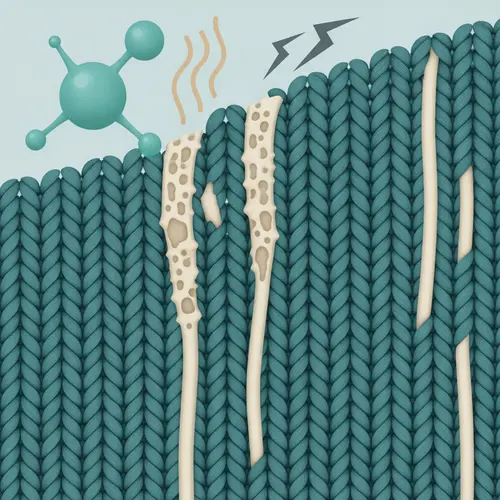
Elastane, also called spandex, is the polyurethane-based fiber that gives many swimsuits their body-hugging fit. Nylon or polyester forms much of the surrounding fabric, while elastane supplies a substantial part of its stretch and restoring force. When that elastic component weakens, the swimsuit may still stretch outward but no longer return firmly to its original dimensions.
An ordinary spandex swimsuit may begin to sag within a season of regular use, with frequent pool exposure bringing problems forward. That is a possible wear pattern, not a fixed lifespan: fiber grade, exposure intensity, construction, and care all affect the outcome.
Chlorine attacks the polymer chains that provide recovery
In pool water, free chlorine exists mainly as hypochlorous acid and hypochlorite, with their balance depending on pH. Hypochlorous acid is a reactive oxidizing agent that can attack the polymer chemistry of swimwear fibers. Conventional elastane is often a particularly vulnerable component of the blend.
Repeated exposure weakens the elastic network. Initially, the change may be difficult to see. Later, straps require more adjustment, leg openings stop sitting securely, and the seat remains stretched after the swimsuit comes off. A polyester base yarn does not automatically prevent these problems if the fabric still relies on unprotected elastane for recovery.
The scale of deterioration can be substantial. A 2024 study published in Polymers tested nine commercial knitted swimwear fabrics and reported a reduction of up to 65.7% in breaking force in the direction of the loop columns after a protocol involving 300 hours in chlorinated water followed by ten washing cycles. This was a tensile-loading strength measurement, not a measurement of elastic recovery, and it should not be treated as a universal 300-hour failure threshold.
For procurement, the distinction matters. A fabric can feel stretchy even after losing considerable strength. Stretch, recovery, and resistance to breakage need separate acceptance criteria.
Heat accelerates fiber degradation
Hot water, tumble dryers, hot tubs, and thermal pools expose elastane to elevated temperatures. Heat can accelerate chemical ageing, including damage associated with oxidizing pool chemicals, and can also contribute to polymer deterioration independently.
A warm, chemically treated pool therefore presents a different challenge from occasional swimming in cooler water. Likewise, repeated tumble drying adds thermal exposure after the garment has already experienced stretching and pool chemicals.
Brands developing resort, spa, or swim-training collections should define these environments during sourcing. A fabric selected only for its initial softness and stretch may not retain the same performance under repeated warm-water use.
Sunscreen and oils can undermine restoring force
Some sunscreens, tanning products, and lotions contain mineral oils that can swell susceptible spandex fibers and compromise their restoring force. Natural body oils are a separate exposure; they should not be described as mineral oil. The effect depends on the fiber formulation, product ingredients, contact time, and whether residues remain in the fabric.
Straps, bust panels, and the seat deserve particular attention because transferred sunscreen or oils can coincide with sustained tension and repeated movement. They may show localized loss of support before the rest of the garment looks worn. However, there is no universal order in which these areas fail.
For a private-label bikini or one-piece collection, this makes oil resistance a relevant sourcing question alongside chlorine resistance. The intended customer may spend more time wearing sunscreen beside a pool than swimming in it.
UV exposure ages beach-only swimwear too
A swimsuit does not need to enter a chlorinated pool to lose elasticity. Prolonged ultraviolet exposure can degrade elastane and other components of the fabric. Beachwear worn repeatedly in strong sunlight can therefore lose recovery even when pool chlorine is absent.
The LYCRA Company states that LYCRA XTRA LIFE fiber resists damage from chlorine, UV rays, heat, sunscreen, and lotions, and can last up to ten times longer than ordinary, unprotected spandex in its laboratory and real-pool comparisons. This is an upper-bound comparative claim, not a guarantee that every finished swimsuit will last ten seasons. Buyers still need evidence for the selected fabric and its intended use.
Mechanism 2: The Knit Structure Determines How Stretch Becomes Recovery
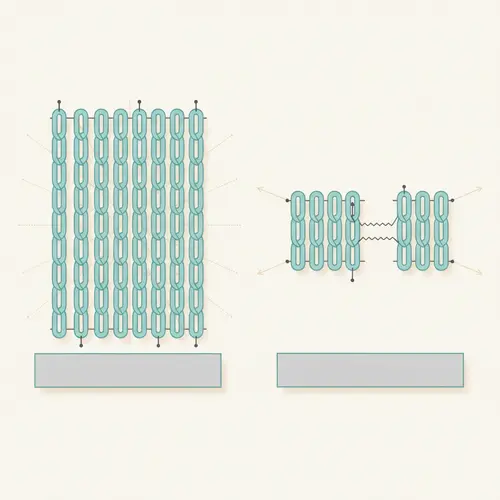
Fiber composition does not tell the whole story. Two fabrics with similar nylon and elastane percentages can behave differently because their yarns are arranged differently.
Stretch describes how far a material extends under load. Recovery describes how effectively it returns after the load is removed. A fabric advertised as four-way stretch can perform well on the first measure and poorly on the second.
Warp knitting distributes tension through connected loops
In common warp-knit swimwear constructions, yarns form lengthwise loop columns and connect across neighboring columns through their lapping paths, often creating a zigzag arrangement. This connected structure helps distribute tension and restrain uncontrolled movement within the fabric.
Well-engineered warp knits generally offer strong dimensional stability and controlled stretch. These characteristics make them useful for fitted swimwear where consistent coverage and support matter over repeated wear.
However, “warp knit” is not a guarantee of perfect recovery or zero size change. Elastane grade, yarn size, stitch density, finishing, and the loads imposed by the pattern still influence performance. The construction gives a useful foundation; testing establishes whether the chosen fabric actually meets the specification.
Weft knitting can provide generous stretch without equivalent shape retention
Weft-knit fabrics form loops across successive rows. Depending on the stitch structure and elastane incorporation, they can offer soft handling and generous multidirectional stretch—qualities that work well for many fashion-led designs.
In a loosely constructed or poorly balanced weft knit, repeated extension can leave residual deformation as loops and yarns fail to return fully. Small amounts of lasting set can accumulate into a loose bust panel or baggy bottom, even while the fabric remains easy to stretch by hand.
That does not mean every weft knit has weak recovery. Well-designed interlock and other elastane-containing weft knits can recover effectively. Neither knit family should be approved or rejected on its name alone.
The manufacturing lesson is that stretch recovery is a fabric-system property, not just a fiber property. Buyers need to evaluate the combination of yarn, elastane, loop geometry, density, and finishing. Increasing the spandex percentage is not a reliable substitute for engineering that combination.
Mechanism 3: Washing and Care Habits Amplify Existing Weaknesses

Care habits influence the rate of failure, but they are not a replacement for durable materials and sound construction. They mainly change how long chemicals remain in contact with the fabric and how much mechanical or thermal stress the garment experiences.
Not rinsing after wear leaves pool chemicals, sunscreen, and oils in contact with the fibers for longer. Wringing concentrates twisting forces into small areas. Machine washing introduces repeated agitation, rubbing, and spinning that can strain loops, seams, and already weakened filaments. Tumble drying adds heat to those mechanical stresses.
Prolonged drying in direct sunlight adds further UV exposure. Chlorine bleach introduces an additional oxidizing treatment. Fabric softeners can leave deposits and alter surface behavior, so they should not be assumed compatible with performance swimwear fabrics.
These are different failure pathways: retained chemicals prolong exposure, harsh handling increases mechanical damage, and heat accelerates degradation. A care label that simply says “wash gently” does not explain enough to help customers avoid them.
At the same time, brands should not attribute every sagging complaint to customer care. If support disappears after limited use, the investigation should also examine the approved fabric, production lot, seam tension, and pattern strain. Care is an amplifier—not an automatic explanation for a product that was under-specified from the start.
How TideLine Turns Elasticity Into Three Production Deliverables

For custom swimwear, the practical response is not simply to request “better fabric.” TideLine's approach brings elasticity into three concrete parts of development: the fabric specification, the construction plan, and the information supplied with the garment.
1. Write measurable elasticity requirements into the tech pack
The tech pack should identify the elastane percentage and grade, the nylon or polyester base yarn, and whether the fabric is warp knitted or weft knitted. Fabric weight and density should also be documented so that a substitute material cannot be approved on composition alone.
Four-way stretch needs measurable acceptance criteria. Specify extension in both length and width, the applied load or target extension, the number of loading cycles, and the recovery interval. Record both recovery percentage and residual growth—the extension that remains after unloading and resting.
For example, an illustrative development requirement could specify at least 95% recovery of the applied extension after 20 cycles to 50% extension and a 30-minute rest, assessed in both principal directions. Those values are not a universal swimwear standard; the brand and supplier must agree on a suitable method and targets for the fabric, fit, and end use.
Check performance in dry and wet conditions, then establish any required post-ageing limits. Chlorine exposure should have a defined concentration, pH, temperature, and duration. UV, heat, and sunscreen or oil exposure can be included where relevant to the collection. A report without those conditions does not provide a reliable basis for comparing fabrics.
For TideLine projects, these decisions belong in sample approval and production documentation. The test scope and cost should be agreed before bulk manufacture, including for a small launch order. The deliverable is a fabric specification with clear pass-or-fail requirements—not an unsupported promise that a material is “high stretch.”
2. Match seams and pattern engineering to the fabric
A fabric that recovers well can still fail in a poorly assembled swimsuit. If a seam cannot extend with its panel, strain concentrates around the stitching. If the pattern demands excessive stretch, the fabric remains under high tension throughout wear.
Stretch-compatible thread and stitch formation should be selected together. Flatlock or other suitable low-profile stretch seams can accommodate movement, while appropriately designed bar tacks can reinforce localized attachment points such as straps. Stitch density and thread tension need control: excessive reinforcement can create a rigid stress point rather than solve one.
Bust and seat areas may benefit from denser, more stable structures or carefully selected support linings. These choices should be checked for recovery, wet opacity, comfort, and compatibility with the outer fabric. Greater density is useful only when it improves the garment's overall behavior.
Pattern engineering should also account for negative ease—the extent to which the garment is smaller than the body so that it fits under stretch. Different fabrics require different allowances. A bikini bottom and a supportive one-piece should not automatically use the same stretch assumptions.
Adding tighter elastic or relaxing the size specification is not a cure for weak fabric recovery. Edge elastic can control an opening, but it cannot restore a deteriorating panel. TideLine's construction deliverable should connect seam choices, reinforcement locations, and fit allowances to the approved material, then verify them in garment samples after repeated extension and relevant exposure.
3. Supply care information as part of the branded product
The third deliverable is a consistent care label supported by a branded care card. Cold-water hand washing, gentle water removal without wringing, flat drying in the shade, and avoiding tumble drying should be clear and consistent with the approved fabric and trims. Immediate rinsing after pool or beach use should also be explained.
This information belongs in the packaging specification, not in an optional message sent after a complaint. Consistent instructions help customers preserve the performance built into the garment and give the brand a clearer basis for handling support requests.
TideLine supports orders starting at 30 pieces. A small run can still carry an agreed fabric specification, a documented construction plan, and coordinated care information. These deliverables make low-MOQ development useful for testing a collection without treating product durability as something to address only after scaling.
Care communication can support a better repeat-purchase and returns experience, but it must not promise restoration. Rinsing removes residues; it does not repair broken elastane chains. Temporary deformation may ease after unloading and resting, but permanent fiber degradation cannot be reversed by a detergent, conditioner, or soak.
Develop Custom Swimwear With Elasticity Specified From the Start
If you are planning a private-label collection, refining an existing fit, or investigating swimwear that loses support too quickly, contact TideLine to discuss custom swimwear, OEM/ODM development, and brand cooperation services. Share your intended use, fit requirements, and target market so the fabric specification, seam construction, and care information can be developed together. With orders starting at 30 pieces, brands can begin with a focused collection built around defined performance requirements rather than generic fabric claims.
Frequently Asked Questions
1. Can a swimsuit regain its elasticity after it becomes loose?
Temporary stretching may improve after the fabric rests, but elasticity lost through broken or chemically degraded elastane chains is irreversible. Washing and soaking can remove residues; they cannot rebuild the polymer structure. Brands should distinguish temporary deformation from permanent loss of recovery when assessing a complaint.
2. Does a higher spandex percentage make swimwear last longer?
Not necessarily. More spandex may change stretch and support, but durability also depends on the elastane grade, base yarn, knit structure, finishing, and exposure conditions. A higher percentage of conventional spandex does not guarantee better chlorine resistance. Compare measured recovery before and after relevant ageing tests.
3. Is warp-knit fabric always better than weft-knit fabric for swimwear?
Warp knits generally offer good dimensional stability and controlled stretch, but neither construction guarantees superior recovery in every application. Well-engineered weft knits can also perform well. Buyers should select the fabric against the collection's fit requirements and cyclic-recovery results rather than relying on the knit name alone.
4. What should buyers request to verify chlorine-resistant swimwear fabric?
Request the identified elastane grade, fabric composition, and a test report showing exposure conditions and measured results. Ask for post-exposure recovery as well as breaking strength, since they describe different properties. Confirm that the report applies to the proposed fabric, and verify the assembled garment separately where seams or trims affect performance.
5. Why do swimsuit straps, bust panels, and the seat become loose first?
These areas often experience sustained tension, repeated movement, and transferred sunscreen or oils. Localized fabric ageing, excessive pattern strain, or incompatible seams can therefore show up there early. They are useful inspection points, although not every swimsuit fails in the same sequence. The solution should address the fabric and construction, not simply tighten the edge elastic.