
When launching or scaling a swimwear brand, choosing the right manufacturing partner is the most critical decision you will make. For years, the industry debate has centered around two major hubs: Bali and China.
Bali has successfully marketed itself as the destination for artisanal, small-batch, and sustainable swimwear. Meanwhile, some marketing narratives have unfairly painted China as a place only suitable for rigid, mass-market production with "long lead times" and "communication barriers." However, in 2026, these outdated stereotypes no longer reflect reality.
As a leading custom swimwear manufacturer based in Xingcheng, China—the global capital of swimwear—TideLine Swimwear is here to debunk the myths. This article provides a data-driven, objective comparison between China and Bali swimwear manufacturing, helping you make the smartest supply chain decision for your brand's growth, profitability, and quality.
The Manufacturing Landscape: Artisanal Charm vs. Industrial Might
The fundamental difference between Bali and China lies in their supply chain infrastructure. Bali's appeal is undeniable; it offers a relaxed, creative environment with a focus on handcrafted details. Many emerging brands are drawn to the island's boutique workshops and the "Bali-made" aesthetic. However, this artisanal approach comes with inherent limitations when it comes to scalability and material sourcing.
In contrast, China offers a vertically integrated, high-tech manufacturing ecosystem. The city of Xingcheng in Liaoning Province perfectly illustrates this industrial might. As of 2026, Xingcheng is home to over 1,300 swimwear manufacturers and approximately 300 supporting companies, producing around 200 million swimwear items annually . This single city accounts for more than 25% of the global swimwear market share .
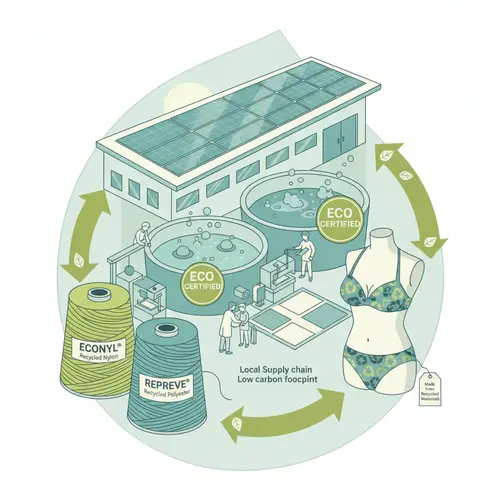
This concentration of expertise means that everything from yarn spinning and fabric knitting to digital printing and final stitching happens within a tightly controlled radius. Unlike Bali, which must import a significant percentage of its fabrics and hardware (often from China itself) , Chinese manufacturers have direct, immediate access to raw materials. This eliminates international shipping delays for fabrics and drastically reduces the carbon footprint associated with material transport.
Comparing the Core Metrics: Speed, Cost, and Flexibility
When evaluating a manufacturing partner, brands must look beyond marketing narratives and analyze the hard metrics that drive business success.
Production Speed and Lead Times
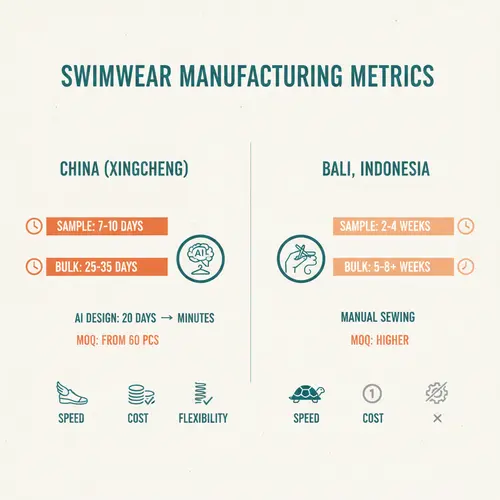
In the fast-paced fashion industry, speed to market is a crucial competitive advantage. The handcrafted nature of Bali manufacturing often results in longer production timelines. Sample creation in Bali can take several weeks, and bulk production frequently requires 5 to 8 weeks or more, depending on the workshop's capacity .
Chinese manufacturers leverage advanced automation and digital design systems to accelerate the process. In Xingcheng, over 1,000 companies utilize AI-powered design systems, which have reduced the new product development cycle from 20 days to mere minutes . For physical samples, Chinese factories typically deliver within 7 to 10 days . Bulk production is equally efficient, generally completed within 25 to 35 days . This rapid turnaround allows brands to react quickly to emerging trends and restock best-selling items before the season ends.
Minimum Order Quantities (MOQs)
A common myth is that Chinese factories only accept massive orders, making them unsuitable for startups. While this was true a decade ago, the landscape has shifted dramatically. Today, agile Chinese manufacturers cater specifically to emerging designers.
At TideLine Swimwear, we understand the financial risks faced by new brands. That is why we offer an incredibly low Minimum Order Quantity of just 60 pieces. This flexibility allows founders to test multiple designs, colors, and sizes without tying up excessive capital in inventory. While Bali is also known for low MOQs, China now matches this flexibility while providing a clearer path to scale up production seamlessly when a brand's volume increases.
Cost Efficiency and Profit Margins
Cost remains a primary factor for any business. Bali's small-batch production and reliance on imported materials inevitably lead to higher per-unit costs. This higher cost is often passed on to the consumer, which may work for luxury boutique brands but can restrict growth for those targeting a broader market.
China's economies of scale, combined with an localized supply chain, offer unparalleled cost efficiency. By eliminating the middleman in fabric sourcing and utilizing automated cutting and sewing technologies, Chinese manufacturers can offer highly competitive pricing without compromising on quality. This efficiency directly translates into healthier profit margins for your brand, providing more capital to invest in marketing, customer acquisition, and design innovation.
Manufacturing Metric | China (Xingcheng) | Bali, Indonesia |
|---|---|---|
Supply Chain | Fully integrated (fabrics sourced locally) | Fragmented (heavily reliant on imported fabrics) |
Sample Lead Time | 7 – 10 Days | 2 – 4 Weeks |
Bulk Lead Time | 25 – 35 Days | 5 – 8+ Weeks |
Scalability | Unlimited (seamless transition from 60 to 100,000+ pcs) | Limited by workshop capacity |
Technology | AI design, digital printing, automated cutting | Manual, traditional methods |
The Truth About Sustainability and Quality
The narrative that Bali holds a monopoly on sustainable and ethical swimwear production is outdated. Chinese manufacturers have made massive investments in green technology and sustainable practices.
Top-tier Chinese factories now routinely utilize certified eco-friendly materials, including recycled nylon (such as ECONYL®) and recycled polyester (like REPREVE®) . Furthermore, China's strict environmental regulations have pushed factories to adopt low-impact dyeing processes and solar-powered facilities. Because Chinese factories source these recycled yarns domestically, the overall carbon footprint of the garment is often lower than shipping the same Chinese-made recycled fabric to Bali for assembly.
Regarding quality, modern Chinese manufacturing relies on precision. While handcrafted items have a unique charm, human error can lead to inconsistencies in sizing and stitching across a bulk order. Chinese factories utilize automated laser cutting for perfect pattern grading and employ multi-stage, data-driven quality control (QC) systems. This ensures that the 1,000th bikini off the line fits exactly the same as the approved sample.
Navigating Global Trade: The Tariff Question
Some competitors highlight US import tariffs as a reason to avoid China. It is true that trade policies fluctuate, and tariffs are a consideration. However, the global trade landscape is complex. For instance, recent agreements have also impacted tariffs on Indonesian imports .
More importantly, the base cost efficiency and speed offered by a Chinese supply chain often offset tariff differences. Furthermore, experienced Chinese manufacturers like TideLine Swimwear have dedicated logistics teams that help brands navigate international shipping, optimize packaging to reduce volumetric weight, and ensure all customs documentation is compliant, minimizing unexpected costs at the border.
Conclusion: Choosing the Right Partner for Your Growth
Bali remains a beautiful destination with a strong artisanal culture, making it a viable choice for hyper-niche, boutique brands that prioritize a specific handcrafted aesthetic over rapid scalability.
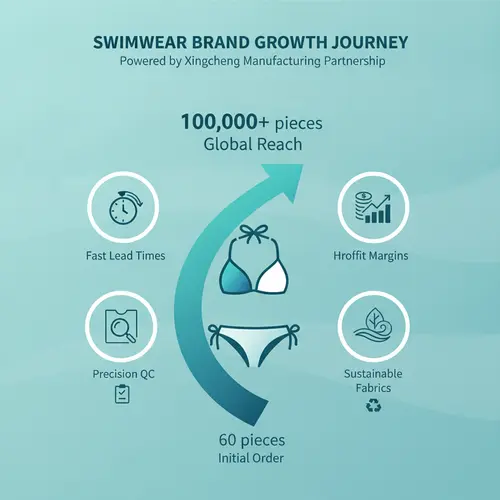
However, if your goal is to build a robust, scalable, and highly profitable swimwear brand, China is the undisputed leader. By partnering with a manufacturer in Xingcheng, you gain access to the world's most advanced textile supply chain. You benefit from lightning-fast lead times, precision quality control, sustainable fabric options, and the flexibility to start with just 60 pieces while having the capacity to produce millions.
Ready to leverage the power of the global swimwear capital for your brand? Contact TideLine Swimwear today to discuss your designs, request a sample, and discover how our agile manufacturing process can accelerate your brand's success in 2026.