The hidden production costs that many new swimwear brands don't discover until they receive their first quotation.
"Why Is This Print So Much More Expensive?"
One of the most common questions we hear from new swimwear brands sounds something like this:
"It's the same fabric. The same bikini. The same amount of printing. Why is the quotation so much higher?"
Usually, the answer is simple.
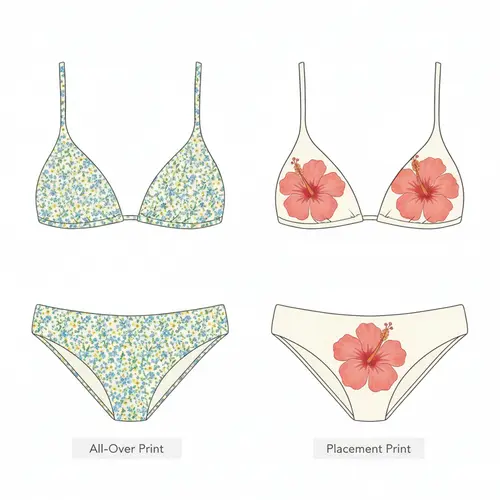
The design uses a placement print.
At first glance, a placement print doesn't seem very different from an all-over print.
Both are printed fabrics.
Both can look equally beautiful.
But from a manufacturing perspective, they are completely different products.
And that's where many first-time brands are caught by surprise.
The Difference Isn't the Printing—It's Everything That Happens After
Many people assume the extra cost comes from the printing process itself.
In reality, printing is only part of the story.
The biggest difference appears after the fabric arrives at the factory.
Imagine your design features a large flower perfectly centered on the front of every bikini top.
Now imagine producing that design in five different sizes.
Every single flower must appear in exactly the same position.
Not approximately.
Exactly.
That single design decision changes almost every production step.
Every Size Needs a Different Pattern Layout
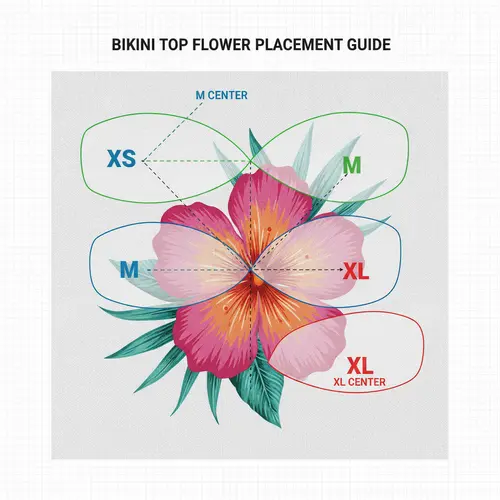
This is something that isn't obvious until production begins.
A size XS and a size XL don't use the same pattern.
Their shapes are different.
Their dimensions are different.
Which means the flower cannot simply stay in the same place on the printed fabric.
Our pattern makers often have to create separate marker layouts for each size to ensure the artwork remains centered after cutting and sewing.
What looks like one print design actually becomes multiple production layouts behind the scenes.
More Precision Means More Labor
With an all-over print, our cutting team has much more flexibility.
Small variations are rarely noticeable because the pattern repeats continuously.
Placement prints are different.
Every panel must be aligned precisely.
Even a shift of one or two centimeters can make the final garment look unbalanced.
That means our production team spends significantly more time:
- Aligning printed panels before cutting
- Matching artwork across seams
- Checking print placement during sewing
- Inspecting every finished garment for consistency
The work becomes slower, more detailed, and less forgiving.
The Hidden Cost Most Brands Never See: Fabric Waste
This is the part that surprises many clients.
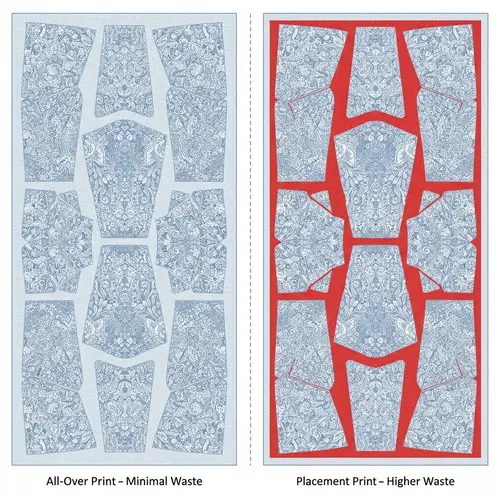
To keep the artwork in exactly the same position, we often can't arrange pattern pieces as efficiently as we normally would.
Instead of maximizing fabric usage, we have to prioritize print placement.
The result?
More unused fabric between pattern pieces.
More offcuts.
More waste.
In some projects, the additional fabric consumption is substantial compared with a standard all-over print.
That extra material cost is built into the quotation—not because we're charging more for the same product, but because producing it genuinely requires more fabric.
It's Not Just About Cost—It's Also About Sustainability
Many new brands tell us sustainability is one of their core values.
If that's true, placement prints deserve careful consideration.
Higher fabric waste doesn't just increase production costs.
It also means more material that cannot be used in the final product.
For brands committed to reducing waste, an all-over print may actually align better with both their environmental goals and their budget.
Sometimes the more sustainable design is also the more commercially practical one.
So Should You Avoid Placement Prints?
Not necessarily.
Placement prints can create a premium, distinctive look that's difficult to achieve with repeating patterns.
For luxury collections or hero products, the extra investment may be worthwhile.
However, if you're launching your first swimwear collection, working with limited production quantities, or trying to control manufacturing costs, it's worth asking an important question:
Does this design benefit enough from a placement print to justify the additional production cost?
Sometimes the answer is yes.
Sometimes an all-over print delivers nearly the same visual impact with far greater manufacturing efficiency.
What We Usually Recommend
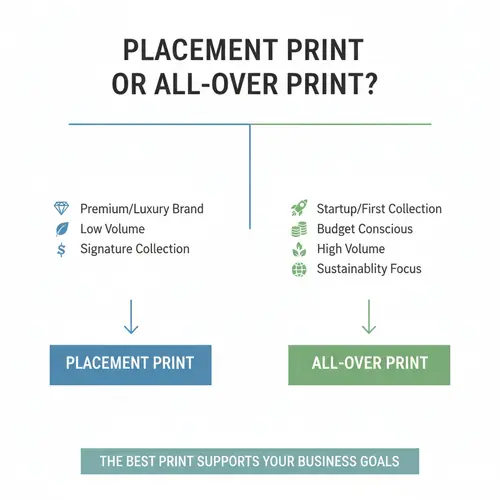
When clients ask us which option they should choose, we don't automatically recommend the cheaper solution.
Instead, we look at the bigger picture.
We consider:
- Your target retail price
- Your production budget
- Your expected order quantity
- Your brand positioning
- Your sustainability goals
- Your long-term product strategy
A premium fashion label launching a signature collection may benefit from placement prints.
A startup introducing its first collection may achieve better margins and greater production flexibility with an all-over print.
The best choice isn't the most beautiful print.
It's the print that supports your business goals.
Final Thoughts
One of the biggest lessons we've learned after manufacturing swimwear for brands around the world is this:
Beautiful designs don't exist in isolation.
Every design decision affects production.
Every production decision affects cost.
And every cost decision affects your business.
Placement prints aren't expensive because factories want to charge more.
They're expensive because they require more planning, more precision, more fabric, and more skilled labor.
Understanding those hidden costs before you finalize your artwork can help you make smarter decisions, reduce unnecessary expenses, and build a collection that's not only beautiful—but also commercially successful.