Swimwear hardware is a small line item with an outsized effect on fit, durability, comfort, and perceived value. A bikini may use only a few rings, sliders, a clasp, or a logo plate, but every component sits where stretch fabric, elastic, water, movement, and skin meet. A slider that slips while wet, a charm that discolours, or a rough clasp edge can turn a well-designed swimsuit into a return or a negative review.
For swimwear brands, private-label buyers, and development teams, hardware must be treated as an engineered trim, not a last-minute decoration. The right choice aligns function, material, finish, dimensions, target price tier, and intended water exposure. This pillar guide explains the core categories, material and finish options, quality controls, compliance discussions, and a practical sourcing method for OEM and ODM programs.
Start with use, not appearance. Define load, skin contact, adjustment needs, water exposure, and brand position before selecting a finish or logo detail.
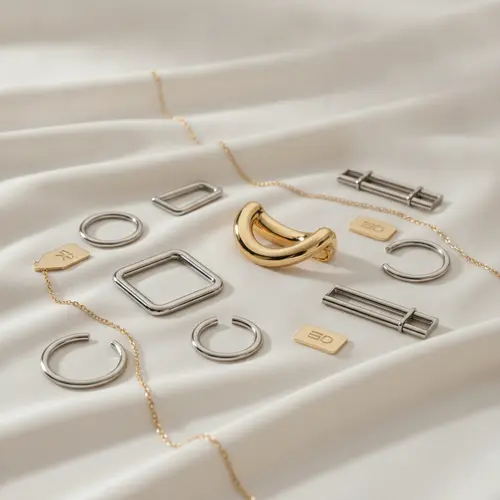
1. What Is Swimwear Hardware and Why Does It Matter?
Swimwear hardware is the metal, resin, or coated trim used to connect, adjust, fasten, reinforce, or decorate a swimsuit. Common parts include rings, sliders, clasps, buckles, charms, chains, eyelets, and stoppers. These compact parts determine how the garment performs where stretch fabric, elastic, water, movement, and skin meet.
Hardware has five linked functions. Structure distributes tension at strap joins, cut-outs, and closures. Adjustment lets the wearer refine strap, neckline, or waist tension. Design expression uses scale, colour, and sheen to support the fabric and silhouette. Brand positioning creates tactile and visible proof of quality that can support a premium retail story. Comfort depends on smooth edges, suitable weight, and considered skin-contact materials.
A good specification considers chlorine, saltwater, sunscreen, sweat, wet-dry cycling, and the component’s exact placement. A slider that creeps, a plated charm that discolours, or a rough clasp edge can undermine an otherwise strong swimsuit.
2. The Eight Essential Types of Swimwear Hardware
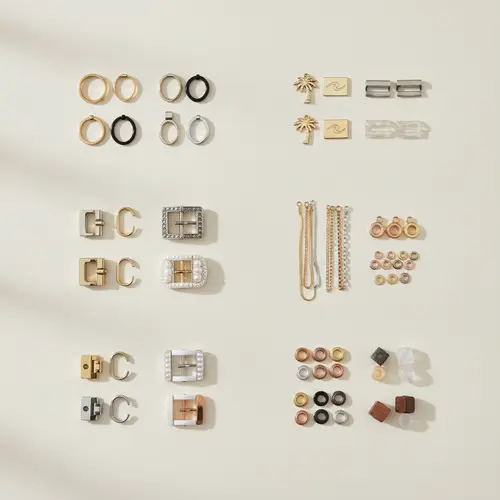
The following are common commercial ranges. Final dimensions must match the finished strap width, fabric thickness, load, and approved production sample.
Type | Common size range | Typical placement | Key buying check |
|---|---|---|---|
Rings | 8–30 mm inside diameter | Strap joins, sides, centre-front cut-outs | Match inner opening and radius to the strap. |
Sliders | 8–20 mm inside width | Adjustable shoulder and halter straps | Test holding power on the actual strap. |
Clasps & hooks | 12–35 mm overall width | Back bands, halter and front closures | Check engagement, load, and smooth edges. |
Buckles | 15–40 mm inside width | Belts, wide straps, centre-front details | Identify functional versus decorative use. |
Decorative charms & logos | 8–35 mm | Centre front, hip, back band, tie ends | Approve artwork, attachment, and skin-facing surface. |
Chain details | 2–8 mm link width; 10–45 cm length | Neckline, waist, sides, and back | Control weight, attachment, and corrosion risk. |
Eyelets & grommets | 3–12 mm inside diameter | Lace-up panels and tie channels | Use smooth edges and reinforced fabric. |
Stoppers | 8–25 mm overall length | Drawstrings, adjustable cups, cord ends | Use a bore that holds without damaging the cord. |
Rings
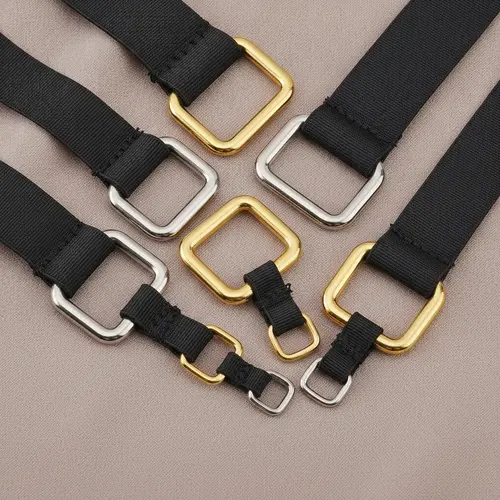
O-rings, D-rings, and rectangular rings connect straps at centre-front, side, and back locations. Use 8–12 mm for narrow straps, 15–20 mm for standard fashion straps, and 25–30 mm for wide straps or belt effects. Check that elastic cannot roll or crease sharply around the part.
Sliders
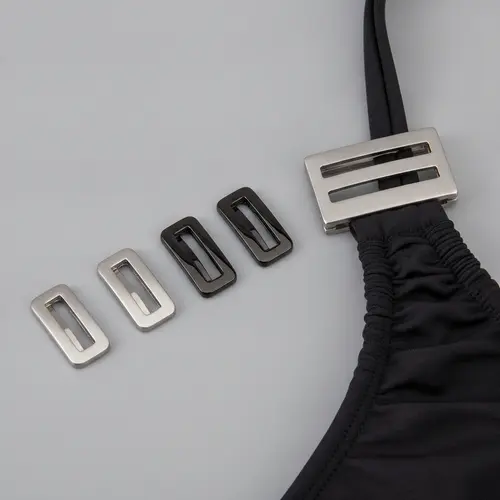
Sliders are usually 8, 10, 12, 15, or 20 mm wide. A 10–12 mm slider suits most bikini straps; 15–20 mm suits broader or higher-support designs. The strap should adjust smoothly but must not creep when wet, stretched, or worn.
Clasps and hooks
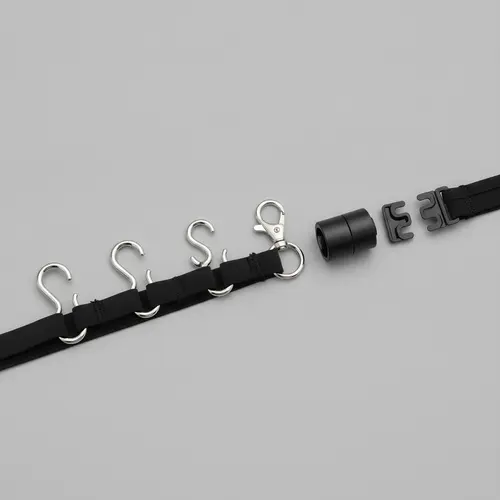
Back clasps, G-hooks, S-hooks, snap hooks, barrel closures, and moulded closures are used on bikini backs, halters, and convertible styles. Select width by back-band support. Every closure needs reliable engagement, acceptable release action, adequate strength, and a smooth surface against skin.
Buckles
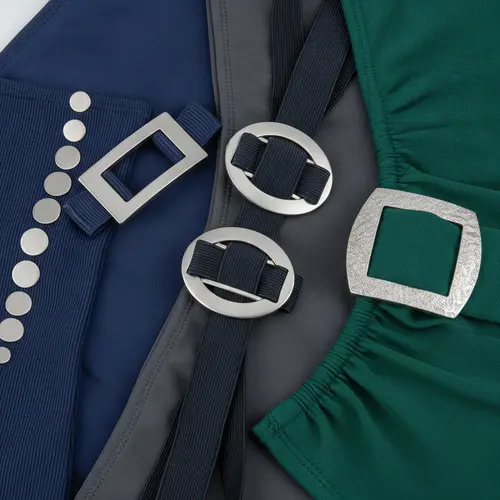
Use 15–20 mm buckles for fashion straps and 30–40 mm for belt-like statements. The tech pack must say whether a buckle adjusts the garment or is sewn in as decoration. Verify its bar opening, corner radius, and weight before approval.
Decorative charms and logo plates
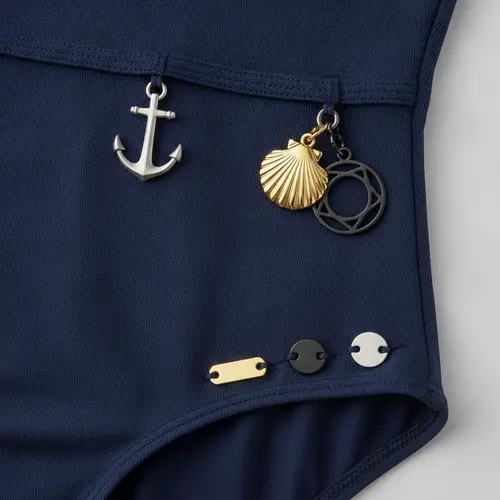
Small 8–18 mm logo plates create a discreet signature; 20–35 mm charms are visible fashion elements. Specify artwork, thickness, finish, attachment, and reverse-side treatment. Keep weight and edges appropriate for the body location.
Chain details

Fine 2–4 mm links are delicate; 5–8 mm links make a bolder statement. Chains can replace a strap section, connect side panels, or drape at the waist. Because they have no elastic recovery, length, weight, attachment strength, and water exposure require close control.
Eyelets, grommets, and stoppers
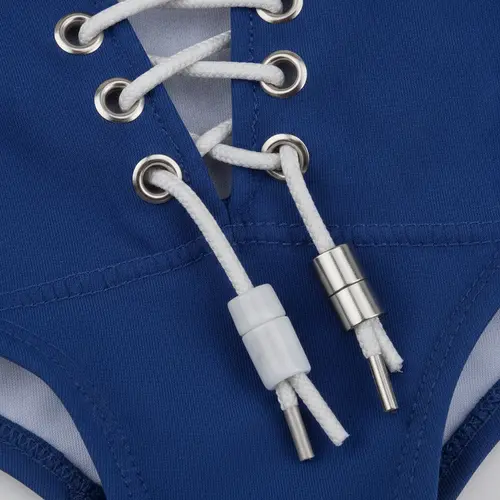
Use 3–5 mm eyelets for fine cords, 6–8 mm for standard swim ties, and 10–12 mm for bold lace-up details. A smooth rolled edge protects cords, fabric, and skin. Stoppers should grip the actual cord under tension; resin supports low-weight sport styles, while metal can elevate resort styling.
3. Six Swimwear Hardware Material Options
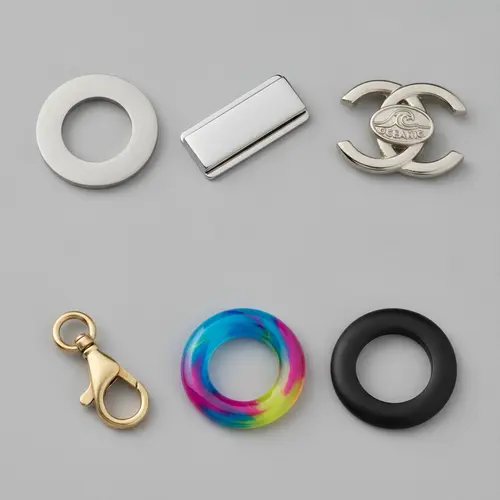
Choose material according to expected product life, water exposure, visible value, and load—not sample appearance alone.
Material or system | Advantages | Limits | Best fit |
|---|---|---|---|
316 stainless steel | High corrosion resistance, strength, premium hand feel | Higher cost and weight | Premium rings, clasps, chains, saltwater ranges |
304 stainless steel | Durable, available, good value | Lower marine resistance than 316 | Standard rings, sliders, buckles |
Zinc alloy | Efficient die-casting and detailed logos | Heavily dependent on coating quality | Decorative buckles, charms, logo plates |
Brass | Premium weight and detailed shaping | Can tarnish; needs controlled top coat | Premium clasps and plated trims |
Resin | Lightweight, colourful, translucent or matte | Lower load capacity; UV performance varies | Stoppers, decorative rings, sport styles |
PVD coating system | Durable colour and strong adhesion on a suitable base | A finish, not a structural material | Black, gold-tone, gunmetal hardware |
316 stainless steel is the strongest choice where corrosion resistance and premium durability are central, especially in saltwater, sunscreen, and repeated wet-dry conditions. 304 stainless steel suits many commercial collections but should not be represented as equivalent to 316 for intensive marine exposure.
Zinc alloy is effective for detailed cast logos and sculptural parts when preparation and coating are controlled. Brass adds valuable weight and detail but needs protection. Resin provides low weight and visual freedom. PVD must always be evaluated with its metal substrate.
4. Four Surface Finishes: Appearance Meets Performance
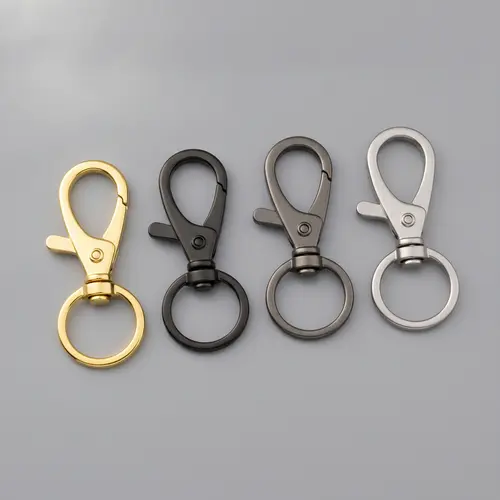
Finish | Main benefit | Production control |
|---|---|---|
Electroplating | Broad colour range and bright metallic effect | Define colour, adhesion, thickness, and corrosion target. |
PVD | Durable black, gold-tone, or gunmetal appearance | For black PVD durability, specify ≥0.5 µm. |
Brushed finish | Modern low-gloss appearance | Approve grain direction, sheen, and consistency on a master sample. |
Gold plating | Classic luxury visual cue | Specify gold plating at ≥0.3 µm. |
Electroplating is versatile but depends on correct cleaning, base preparation, thickness, and sealing. Weak controls can lead to uneven colour, peeling, and early wear. PVD, or physical vapour deposition, provides a hard, well-adhered finish on a compatible substrate; set a ≥0.5 µm target for black PVD durability.
A brushed finish works well for minimal or sports-luxe collections but must have consistent grain and scratch density. Gold plating remains a premium option; set ≥0.3 µm as a practical visible-trim minimum. Moving sliders, chains, and clasp edges may require stronger protection because friction accelerates wear.
5. Four Core Quality Indicators
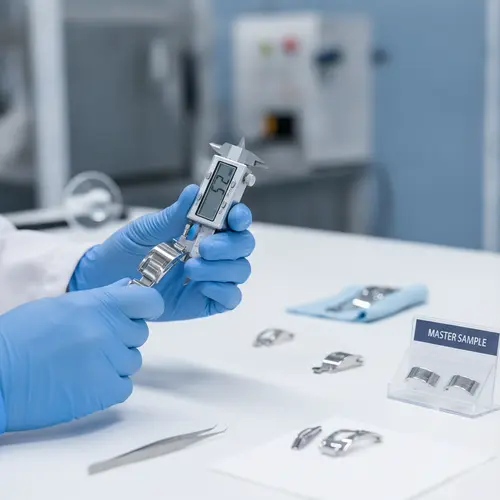
First, confirm the base material. “Metal” is not an adequate specification. The supplier should declare whether the part is 316 stainless, 304 stainless, brass, zinc alloy, or another identified material, and bulk production should match the approved sample.
Second, set coating thickness for all plating or PVD. Include measurable targets in the specification, such as gold plating at ≥0.3 µm or black PVD at ≥0.5 µm, plus an agreed checking method.
Third, inspect surface-treatment quality for burrs, sharp edges, pinholes, rough casting seams, peeling, uneven colour, and inconsistent brushing. Inspect inside radii, moving bars, chain joints, and logo-plate backs, where abrasion or corrosion can start.
Fourth, control mechanical tolerance. Confirm inside width, bar thickness, clasp alignment, opening dimension, slider clearance, and component weight. A one-millimetre change in a slider channel can make a strap impossible to thread or too loose to hold. Record critical dimensions on a drawing or control standard.
6. Key Standards and Certification Discussions
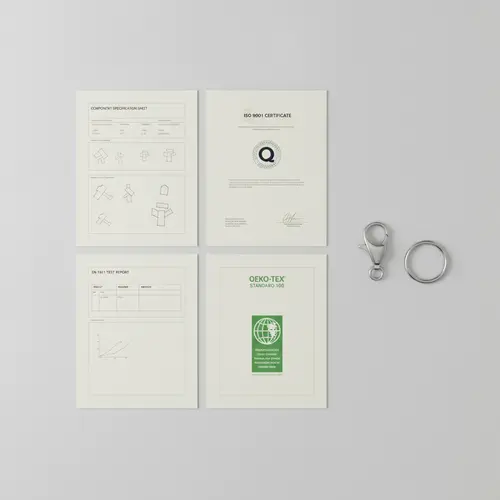
Standard or system | Why it matters | Buyer action |
|---|---|---|
EN 1811 | Addresses nickel release from items intended for direct and prolonged skin contact | Request a current report where applicable. |
ASTM F2129 | Electrochemical corrosion-susceptibility method associated with metallic medical devices | Use only when a buyer requires it as an engineering screen. |
ISO 9001 | Assesses the supplier’s quality-management system | Verify scope, validity, traceability, and inspection practice. |
RoHS | Restricts certain hazardous substances in relevant electrical/electronic settings | Clarify whether a declaration is contractually required for non-electrical trims. |
OEKO-TEX® STANDARD 100 | Harmful-substance framework for textiles, accessories, and components | Check that the certificate scope covers the supplied trim or article. |
EN 1811 is relevant for metal hardware with direct and prolonged skin contact because it assesses nickel release. ISO 9001 describes the supplier’s quality-management system, rather than proving one clasp or ring’s performance. OEKO-TEX® STANDARD 100 supports a harmful-substances strategy, but buyers should confirm that its scope includes the relevant accessory or finished product.
ASTM F2129 should be handled precisely. It is not a standard swimwear-hardware certification; it is an electrochemical corrosion method associated with metallic medical devices. It may be useful when a technically demanding buyer requests a defined corrosion screen, but should not be marketed as a general apparel compliance claim. RoHS may appear in declarations, although its relevance to non-electrical swimwear hardware should be clarified contractually.
7. Four Supplier Types Compared

Supplier type | Advantages | Limits | Best use |
|---|---|---|---|
Etsy-style retail sellers | Fast, small quantities, trend exploration | Limited repeatability and documentation | Concept development, not controlled production |
General B2B platforms | Broad selection and scalable quotations | Buyer manages verification and quality variation | Brands with clear specifications and sourcing capability |
European certified factories | Strong compliance orientation and process discipline | Higher cost and potentially higher MOQs | Premium, compliance-sensitive launches |
U.S. custom factories | Close collaboration and responsive sampling | Higher unit cost; capacity may be narrower | Custom programs needing frequent iteration |
Channel choice depends on risk, not price. Premium plated clasps need tighter sample, documentation, colour, and bulk-traceability controls than simple resin stoppers.
8. A Five-Step Hardware Procurement Method
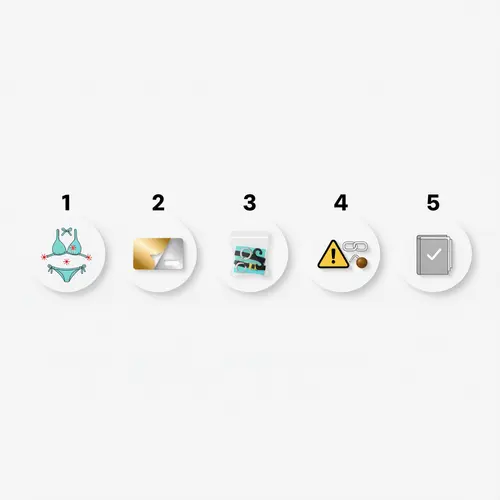
1. Identify stress points. Map each hardware location by load, skin contact, water exposure, movement, and visual importance. A shoulder slider is a functional stress point; a logo plate can be low-load but high-visibility.
2. Verify the coating. For plated or PVD parts, request base material, finish system, thickness target, approved colour, and corrosion-test expectation. Make this requirement contractual rather than verbal.
3. Test before scaling. Approve a production-representative sample with actual fabric, lining, elastic, and stitching. Test adjustment, twist, closure action, edge feel, colour, fabric abrasion, and wet-dry performance.
4. Avoid uncontrolled mixed materials. A 316 stainless ring beside a thin-plated zinc-alloy charm may age differently. If materials are mixed, define the reason, placement, and expected ageing profile.
5. Document the standard. Retain a hardware pack with part code, master-sample photo, dimensions, material, finish, coating target, weight range, assembly method, test requirement, inspection points, supplier, and revision date.
9. Seven Common Swimwear Hardware Mistakes
Selecting for visual appeal without testing load and skin-facing edges.
Matching hardware to cut strap width instead of finished strap width.
Approving “gold plated” without a thickness target.
Testing dry samples only and ignoring chlorine, saltwater, sunscreen, and wet-dry cycles.
Placing heavy or rough decoration at neck, rib, hip, or chest pressure points.
Treating every stainless steel grade as identical in corrosion resistance.
Approving one development sample but not controlling bulk lots against a retained master sample.
10. TideLine Hardware Support for Custom Swimwear
TideLine integrates hardware into custom swimwear development. For OEM and ODM programs, TideLine coordinates rings, sliders, closures, logo trims, and finishes from concept through bulk production. Programs can begin from 30–50 pieces per style, supporting emerging labels, capsule collections, and controlled market tests.
For projects requiring stronger corrosion resistance, TideLine maintains 316 stainless steel stock for appropriate component development. TideLine can also provide EN 1811 reports for applicable metal hardware programs, helping brands create a clearer documentation path for direct and prolonged skin-contact considerations. The objective is a production-ready hardware standard aligned with function, fabric, finish, and commercial position.
Start Your Custom Swimwear, OEM/ODM, or Brand Collaboration Project
TideLine turns new labels, private-label, and resort collections into production-ready swimwear. Share your target customer, fabric, size range, hardware needs, quantity, and market requirements. Support includes custom swimwear development, OEM/ODM manufacturing, branded hardware, sampling, quality documentation, and brand partnership.
Frequently Asked Questions
1. What is the best hardware material for saltwater swimwear?
For demanding saltwater use, 316 stainless steel is generally the strongest common metal option because of its higher corrosion resistance. The final choice should also consider part shape, finish, skin contact, movement, and the product’s care promise.
2. Is 304 stainless steel suitable for bikini rings and sliders?
Yes. 304 stainless steel is a durable, practical option for many standard swimwear programs. For intensive saltwater use or premium corrosion-resistance positioning, 316 stainless steel offers a stronger specification.
3. How thick should gold plating be on swimwear hardware?
Specify gold plating at ≥0.3 µm as a practical minimum for visible swimwear trims. Moving or high-friction parts may require a stronger finish plan because mechanical contact increases wear.
4. Can black PVD be used on swimwear hardware?
Yes. Black PVD can provide a refined, durable finish on a suitable metal base. Where black durability is a priority, specify PVD at ≥0.5 µm and validate the part in the intended water-exposure environment.
5. What documents should a swimwear brand request from a hardware supplier?
Request a component specification sheet, declared base material, finish and coating-thickness information, critical dimensions, an approved master sample, relevant test reports or declarations, and supplier quality-system details. For skin-contact metal components, EN 1811 documentation may be appropriate depending on the product and destination market.